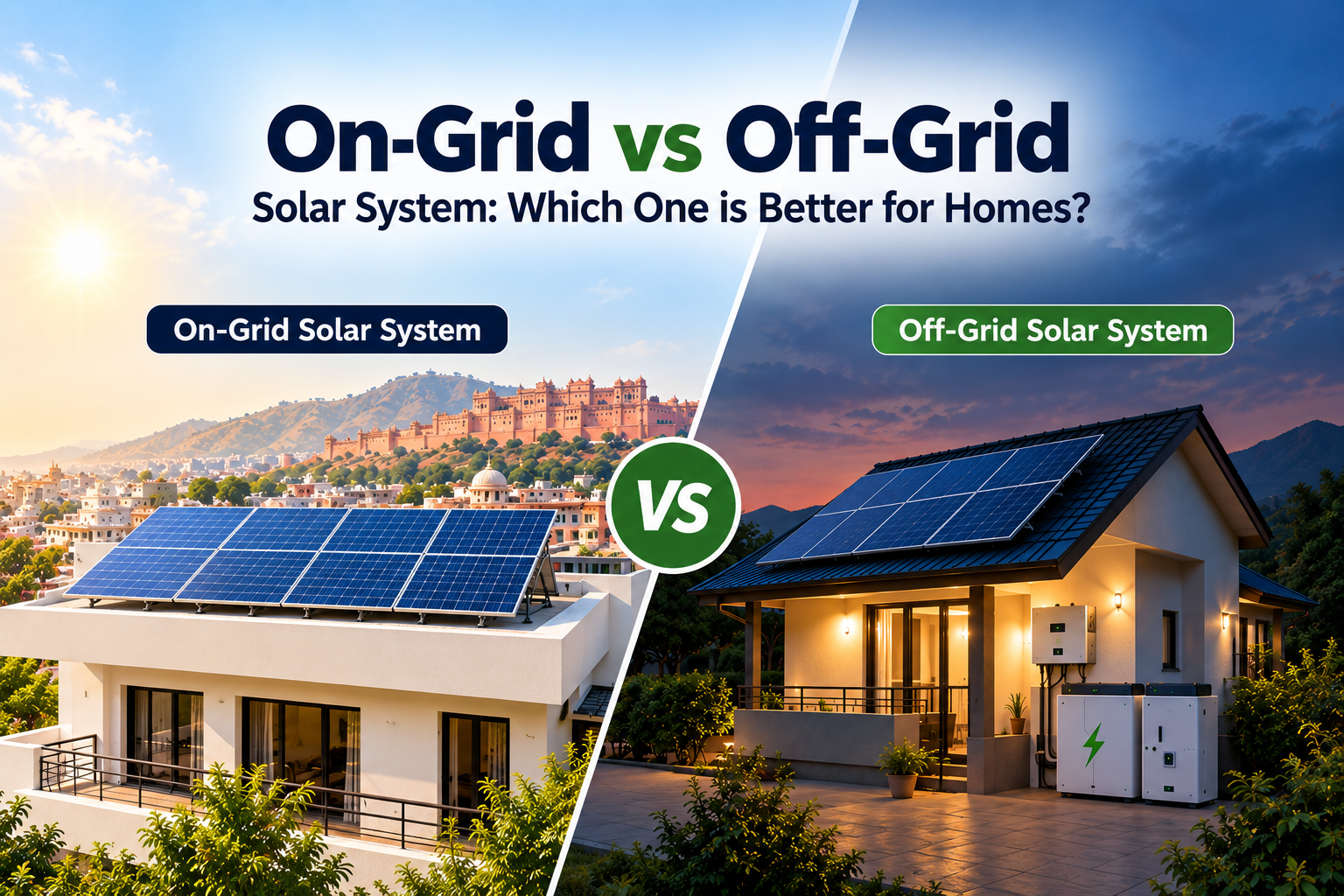
On-Grid vs Off-Grid Solar System: Which One is Better for Homes?
Installing solar panels at home can significantly change the way a household generates and consumes electricity. But before investing in solar system installation for a home, one important question needs to be answered: Should you choose an on-grid or off-grid solar system?
Both systems use solar panels to generate electricity, but they work differently. An on-grid solar system works alongside the electricity grid, while an off-grid solar system operates independently and generally relies on batteries to store excess solar power.
For homeowners in India, the right choice depends on several factors, including your electricity consumption, availability and reliability of grid power, backup requirements, roof space, budget, battery requirements, and eligibility for government incentives.
This guide explains the difference between on-grid and off-grid solar systems, their advantages and disadvantages, installation considerations, costs, maintenance requirements, and which option may be better for different types of homes.
Quick Answer: On-Grid or Off-Grid Solar System?
For most homes with a reliable electricity grid, an on-grid solar system is a cost-effective choice for reducing electricity bills. An off-grid solar system is better suited to locations with unreliable or unavailable grid power because it includes battery storage. A hybrid solar system can be a better option for homeowners who want both solar savings and battery backup during power cuts.
| Feature | On-Grid Solar | Off-Grid Solar | Hybrid Solar |
|---|---|---|---|
| Grid connection | Yes | No | Yes |
| Battery | Usually not required | Required | Yes |
| Backup during power cuts | Generally unavailable | Yes | Yes |
| Net metering | Generally applicable where approved | Not applicable | Depends on system design and applicable regulations |
| Bill reduction | Yes | Limited grid interaction | Yes |
| Energy independence | Low | High | Medium–High |
| Initial cost | Generally lower | Generally higher | Generally higher |
| Best for | Homes with a reliable grid seeking bill savings | Remote or unreliable-grid locations | Homes wanting solar savings plus backup |
What Is an On-Grid Solar System?
An on-grid solar system, also known as a grid-connected solar system, is connected to both your home's electrical system and the local electricity grid.
Solar panels installed on your rooftop generate electricity during daylight hours. A solar inverter converts the electricity into usable AC power for household appliances.
The electricity generated by the system can be used directly by your home. When solar generation is insufficient, such as at night or during periods of low sunlight, electricity can be supplied by the grid.
Depending on applicable state/DISCOM regulations and the connection arrangement, surplus electricity generated by the rooftop system may be exported to the grid through an approved metering arrangement.
How Does an On-Grid Solar System Work?
The basic process is:
Sunlight → Solar Panels → Solar Inverter → Home Appliances → Grid for Additional/Supplementary Power
During the day:
- Solar panels receive sunlight.
- The panels generate DC electricity.
- The solar inverter converts DC electricity into AC electricity.
- Your home consumes the generated electricity.
- Surplus electricity may be exported to the grid where the applicable metering arrangement permits it.
- When solar generation is insufficient, electricity can be drawn from the grid.
One important point homeowners should understand is that a conventional grid-tied solar inverter generally shuts down when the grid fails. This is a safety feature designed to prevent electricity from being fed into a grid that may be undergoing maintenance.
Therefore, an on-grid system should not automatically be considered a power-backup system.
Read more: Which Solar System is Best for Home Use?
What Is an Off-Grid Solar System?
An off-grid solar system is designed to operate independently of the electricity grid.
It typically includes:
- Solar panels
- Solar charge controller or suitable integrated inverter technology
- Solar inverter
- Battery bank
- Mounting structure
- Protection and electrical components
The solar panels generate electricity during the day, while excess energy can be stored in batteries for use when solar generation is unavailable.
How Does an Off-Grid Solar System Work?
The typical flow is:
Sunlight → Solar Panels → Charge Controller/Inverter → Battery + Home Loads
During the daytime, solar electricity can power household appliances while also charging the batteries.
At night or when solar generation is insufficient, the battery can supply electricity to selected or appropriately sized household loads.
This makes off-grid systems particularly useful where grid electricity is unavailable, unreliable, or where independent backup power is an important requirement.
MNRE describes off-grid solar applications as particularly relevant in locations where grid electricity is unavailable or unreliable.
Difference Between On-Grid and Off-Grid Solar Systems
The biggest difference between the two systems is their relationship with the electricity grid and their use of batteries.
An on-grid system is designed primarily to generate solar electricity and work with the grid. An off-grid system is designed to provide electricity independently and therefore needs energy storage to bridge the gap between solar generation and consumption.
1. Grid Connection
An on-grid system remains connected to the electricity grid.
An off-grid system does not depend on the grid for its normal operation.
Best for:
Homes with dependable electricity generally have an advantage with on-grid systems, while properties without reliable grid access may benefit from off-grid solar.
2. Battery Requirement
Conventional on-grid systems generally do not require battery storage because they remain connected to the electricity grid. Off-grid systems require batteries to store solar energy for use when solar generation is unavailable. Battery storage is also a key component of hybrid systems that provide backup power.
3. Power During Electricity Cuts
Conventional on-grid systems generally do not provide backup during grid outages, while appropriately designed off-grid and hybrid systems can supply selected loads using battery storage.
4. Initial Investment
On-grid systems are generally less expensive than comparable off-grid systems because they normally do not require a large battery bank.
Off-grid systems can cost more because the system needs adequate battery storage and additional equipment to operate independently.
However, the exact price depends on:
- Solar capacity
- Panel technology
- Inverter type
- Battery technology and capacity
- Mounting structure
- Electrical work
- Roof conditions
- Installation complexity
- Backup requirements
Homeowners should therefore compare complete system quotations rather than comparing only the price per solar panel.
5. Maintenance
On-grid systems generally have fewer components requiring ongoing maintenance because they typically do not use a battery bank.
Off-grid systems require additional attention to battery health, system settings, charge/discharge cycles, and backup capacity.
The maintenance requirement depends on the technology selected and how the system is operated.
Read more: How Can Solar Reduce Business Electricity Bills?
Advantages and Disadvantages of an On-Grid Solar System
Advantages of On-Grid Solar
- Lower Initial System Cost: Since batteries are generally not required, an on-grid solar system usually has a lower upfront cost than a comparable off-grid system.
- Reduced Electricity Bills: Solar power generated during the day can offset electricity purchased from the grid, helping homeowners reduce their monthly electricity expenses.
- Efficient Use of Grid Infrastructure: When solar generation is insufficient, the home can continue drawing electricity from the grid, providing flexibility throughout the day and night.
- Suitable for Urban Homes: On-grid rooftop solar is often a practical option for homes in cities and towns with reliable electricity connections and suitable rooftops.
- Potential Government Financial Assistance: Eligible residential consumers with grid-connected electricity connections may qualify for applicable government rooftop solar financial assistance. Under the PM Surya Ghar Muft Bijli Yojana, Central Financial Assistance is available for eligible residential rooftop solar systems, subject to the scheme's eligibility requirements, approved procedures, and applicable regulations.
- No Large Battery Bank: Conventional on-grid solar systems generally do not require battery storage, which reduces both the initial investment and the maintenance requirements associated with battery systems.
Disadvantages of On-Grid Solar
- Limited Backup During Power Cuts: A conventional on-grid solar system generally shuts down when the utility grid goes down for safety reasons. It does not normally provide backup power unless additional backup equipment or battery storage is included.
- Dependence on the Grid: The system remains connected to the local electricity network, so its operation and electricity usage are still linked to the availability and regulations of the grid.
- Net Metering and Export Rules Matter: The financial benefit from surplus solar electricity depends on applicable state regulations, metering arrangements, DISCOM procedures, and the rules governing electricity exported to the grid.
Advantages and Disadvantages of Off-Grid Solar Systems
Advantages of Off-Grid Solar
- Works Independently of the Grid: An off-grid solar system can generate and store electricity without depending on a utility grid connection.
- Provides Backup During Power Cuts: With adequately sized batteries and solar generation capacity, an off-grid system can continue supplying electricity when grid power is unavailable.
- Useful for Remote Locations: Off-grid solar can be particularly valuable for homes, farms, or properties where grid electricity is unavailable, unreliable, or difficult to access.
- Greater Energy Independence: Homeowners can generate and store their own electricity, reducing their dependence on conventional grid supply.
Disadvantages of Off-Grid Solar
- Higher Initial Investment: Off-grid systems generally cost more because they require batteries, charge-control equipment, and other components needed for independent operation.
- Battery Replacement: Batteries have a finite service life and may eventually need to be replaced, adding to the system's long-term ownership cost.
- More Careful System Planning Required: An off-grid system must be properly sized according to electricity consumption, solar generation, battery capacity, and backup requirements. Undersizing any of these components can affect power availability.
- Heavy Loads Require Appropriate Sizing: Appliances such as air conditioners, electric geysers, water pumps, refrigerators, and other high-consumption equipment can significantly increase electricity demand. An off-grid system must be appropriately sized to handle the required loads without unnecessarily draining the batteries.
On-Grid vs Off-Grid Solar: Which Is Better for Indian Homes?
There is no universal answer because every home has different electricity consumption and backup requirements.
However, the following approach can help.
Choose On-Grid Solar If:
- Your home already has a reliable electricity connection.
- Your primary goal is reducing electricity bills.
- You want a lower initial investment.
- You have adequate rooftop space.
- You do not require solar power to operate during every grid outage.
- You want to explore eligible residential rooftop solar incentives.
- Your local regulations support the required grid-connected arrangement.
Choose Off-Grid Solar If:
- Your property does not have reliable grid electricity.
- You live in a remote area.
- Power outages are frequent, and backup is essential.
- You want an independent electricity system.
- You are prepared to invest in batteries.
- Your electricity loads can be appropriately managed and sized.
What About a Hybrid Solar System?
There is also a third option that homeowners should know about: the hybrid solar system.
A hybrid system combines grid connectivity with battery storage.
It can allow a home to use solar power, interact with the electricity grid, and maintain battery backup for selected loads, depending on the equipment and configuration.
For homeowners who want both electricity-bill savings and backup power, a properly designed hybrid system may be worth considering.
Hybrid systems generally involve additional equipment and therefore may cost more than basic grid-connected systems.
The best option depends on whether your priority is:
Lower investment → On-grid
Maximum independence → Off-grid
Solar savings + backup → Hybrid
Solar System Installation for Homes in Jaipur
For homeowners considering a solar system in Jaipur, the first step should be understanding the home's electricity consumption, rooftop conditions, and local electricity connection.
Jaipur receives strong sunlight for much of the year, making rooftop solar an attractive option for many residential properties. More broadly, most parts of India receive around 4–7 kWh/m²/day of solar energy, supporting the potential for residential solar generation.
For a typical urban home in Jaipur with a stable grid connection, an on-grid system may be a practical starting point for reducing electricity costs. Homes that experience frequent power cuts or need critical appliances to remain operational during outages may instead consider a hybrid or off-grid configuration.
Homes in Jaipur should also consider rooftop shading, terrace layout, dust accumulation, mounting structure requirements, electrical safety, and the applicable electricity distribution and metering process when planning rooftop solar. These factors can affect system design, installation requirements, generation performance, and long-term maintenance.
If you are comparing solar panels in Jaipur, do not evaluate the panel alone. Consider the complete system, including the solar panels, inverter, mounting structure, electrical protection, installation quality, warranties, monitoring, after-sales support, and the installer's ability to assist with the relevant DISCOM and metering process.
For homeowners exploring reliable solar solutions in India, choosing an experienced installer and getting a proper site assessment can help ensure that the system is designed around actual electricity consumption and rooftop conditions.
Read more: How to Apply for a Solar Subsidy in India?
What to Consider Before Solar System Installation for Home
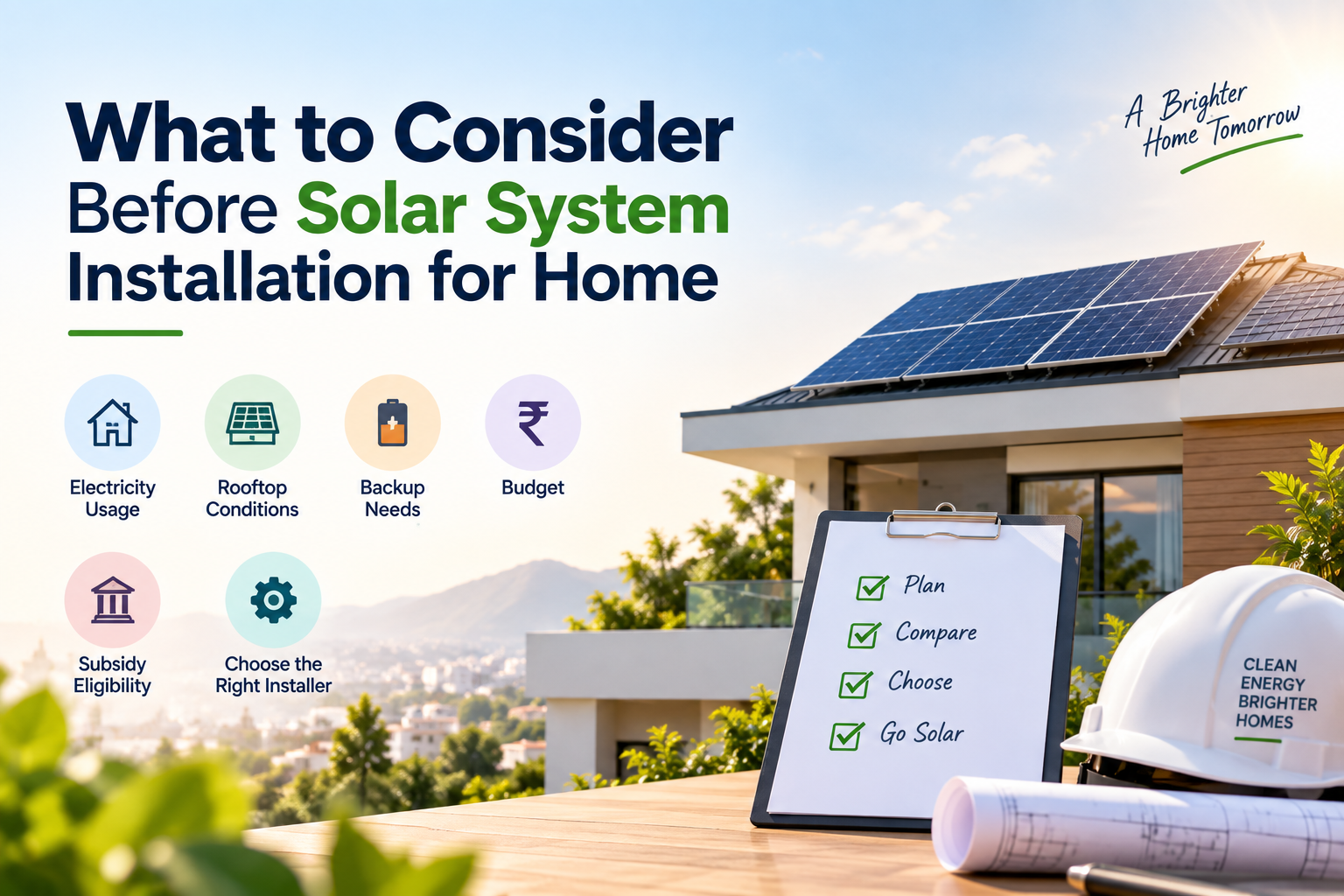
Before starting a home solar system installation, homeowners should consider electricity usage, rooftop conditions, backup needs, system capacity, battery requirements, subsidies, and installer quality.
1. Analyze Your Electricity Consumption
Review your electricity bills from the last 6–12 months and check:
- Average monthly usage
- Day and night consumption
- Seasonal changes
- High-energy appliances
- Future electricity needs
This helps determine the right solar system capacity.
2. Check Your Rooftop
Evaluate:
- Available roof area
- Shading
- Roof orientation
- Structural condition
- Panel placement
- Maintenance access
Trees, buildings, and water tanks can create shade and reduce solar generation.
3. Determine Your Backup Requirements
If your main goal is reducing electricity bills and the grid is reliable, on-grid solar may be suitable.
If you need electricity during power cuts, consider an off-grid or hybrid system with appropriate battery capacity.
4. Consider Battery Requirements
For off-grid or hybrid systems, battery sizing should consider:
- Backup duration
- Daily electricity usage
- Connected load
- Critical appliances
- Battery technology
- Future requirements
Proper sizing helps provide reliable backup without unnecessary costs.
5. Check Solar Subsidy Eligibility
The PM Surya Ghar: Muft Bijli Yojana provides central financial assistance for eligible residential rooftop solar systems. The scheme has an approved outlay of ₹75,021 crore and aims to support rooftop solar adoption for one crore households.
Eligibility and procedures depend on the applicable scheme requirements, electricity connection, approved vendors, documentation, and DISCOM processes. Homeowners should verify the latest rules before calculating expected subsidy benefits.
6. Choose a Qualified Solar Installer
Compare installers based on more than price. Check:
- Recommended system capacity
- Panel and inverter specifications
- Mounting structure
- Earthing and electrical protection
- Warranty
- Installation timeline
- Maintenance support
- Metering and grid-connection assistance
- Applicable government procedures
A detailed quotation should clearly mention equipment, installation scope, warranties, and additional costs.
7. Consider Future Electricity Needs
If you may add an AC, electric geyser, water pump, or EV charger, consider these future loads when selecting system capacity.
Planning ahead can reduce the need for costly upgrades later.
How Does Residential Solar Installation Work?
Choosing the right solar system is only the first step. A residential solar installation typically involves several stages, from understanding household electricity consumption to commissioning the system and setting up ongoing monitoring.
1. Electricity Consumption Assessment
The process usually begins by reviewing recent electricity bills and understanding the home's average consumption. Daytime and nighttime usage, seasonal variations, and high-consumption appliances can help determine the appropriate system capacity.
2. Rooftop and Site Survey
The rooftop is assessed for usable space, shading, orientation, structural considerations, access, and potential panel placement. The survey helps identify practical installation requirements before equipment is finalized.
3. System Capacity Planning
Based on electricity consumption, rooftop conditions, sunlight availability, and the homeowner's objectives, the appropriate solar capacity can be planned. Backup requirements should also be considered if a battery or hybrid configuration is being evaluated.
4. Equipment Selection
The system design typically includes solar panels, an inverter, mounting structures, electrical protection components, cabling, and other required equipment. Battery storage may also be included for off-grid or hybrid systems.
5. System Quotation
The homeowner should receive a detailed quotation covering equipment specifications, installation work, warranties, electrical components, applicable taxes or additional charges, and any relevant grid or metering assistance.
6. Installation and Mounting
Once the system design is finalized, the mounting structure is installed and solar panels are positioned according to the approved layout. Proper alignment, secure mounting, cable routing, and access for future maintenance are important considerations.
7. Electrical Connections and Safety Checks
The inverter, wiring, protection devices, and earthing are connected and tested. For grid-connected systems, this stage also involves coordination with the applicable DISCOM procedures and metering arrangement before the system is commissioned.
8. Grid and DISCOM Process Where Applicable
For grid-connected systems, applicable documentation, metering, approvals, and DISCOM procedures may need to be completed. The exact process can vary depending on the local electricity distribution company and prevailing regulations.
9. System Commissioning
After installation and required checks are completed, the system is commissioned. The installer should verify that the solar generation system, inverter, electrical connections, monitoring equipment, and other components are operating as intended.
10. Monitoring and After-Sales Support
After commissioning, homeowners can monitor system performance through the available monitoring solution. Warranty support, maintenance guidance, troubleshooting assistance, and after-sales service should also be considered when selecting an installer.
A structured installation process helps homeowners understand not only the equipment they are purchasing but also the site assessment, electrical work, regulatory requirements, commissioning, and support involved in a residential solar project.
Read more: How Much Does Solar Panel Installation Cost in Jaipur in
How Much Solar Capacity Does a Home Need?
There is no single solar capacity that works for every house. The right solar system for home depends on electricity consumption, available rooftop space, sunlight exposure, system losses, appliance usage, and future energy requirements.
A home's required system size depends on electricity consumption, location, available roof area, solar irradiation, system losses, panel technology, and the desired level of energy offset.
As a general planning approach, homeowners should first analyze their electricity bills rather than selecting a system purely based on roof size.
For example:
- A smaller household with moderate electricity consumption may need a smaller rooftop system.
- A larger home with multiple air conditioners and other high-load appliances may require significantly greater capacity.
- An off-grid home may require additional capacity because the system must also account for battery charging and periods of low solar generation.
A solar installer should perform a proper site and load assessment before recommending the final capacity.
Expert Tip: Don't Size a Solar System From the Roof Area Alone
A common mistake is choosing a solar system based only on the available rooftop area. In practice, system sizing should start with electricity consumption and then consider roof orientation, shading, available installation area, daytime usage, inverter configuration, and backup requirements. A proper site assessment can help avoid both undersizing and unnecessary system capacity.
What Does Home Solar System Installation Cost?
The cost of solar installation for homes varies depending on system capacity, panel and inverter selection, battery requirements, roof conditions, installation complexity, and applicable incentives
Factors that influence the final quotation include:
- Solar system capacity
- Solar panel brand and technology
- Inverter type
- Battery capacity, if applicable
- Mounting structure
- Roof type
- Electrical upgrades
- Installation complexity
- Safety equipment
- Monitoring system
- Applicable subsidy or financial assistance
- Local DISCOM requirements
Instead of asking only, "What is the price of a 3 kW solar system?" homeowners should ask:
"What is the complete installed cost after applicable incentives, and what exactly is included?"
A detailed quotation should clearly identify equipment, installation, warranties, protection systems, and any additional charges.
On-Grid vs Off-Grid Solar System: Cost Comparison
There is no single price difference between on-grid and off-grid systems because battery capacity, equipment selection, and installation requirements can vary significantly.
The following is a practical comparison rather than a fixed market price:
| Cost Factor | On-Grid | Off-Grid |
|---|---|---|
| Solar Panels | Required | Required |
| Inverter | Required | Required |
| Battery | Usually not required | Required |
| Installation | Required | Required |
| Electrical Protection | Required | Required |
| Battery Replacement | Usually not applicable | Applicable over system life |
| Overall Upfront Cost | Often lower | Often higher |
| Backup Capability | Limited in conventional configuration | Yes |
Actual costs should always be obtained from a site-specific quotation rather than relying on generic online estimates.
Read more: Solar vs Electricity Cost in India
Is Solar Worth It for Homes in India?
For many households, rooftop solar can be financially attractive because solar panels can generate electricity over a long operating period while reducing reliance on purchased grid electricity.
However, whether solar is financially worthwhile depends on:
- Electricity tariff
- Monthly electricity consumption
- Solar generation
- System cost
- Financing
- Government incentives
- Battery requirements
- Self-consumption
- Applicable electricity regulations
For a grid-connected home, the financial calculation can be particularly different from an off-grid system because battery costs can significantly affect the investment.
Therefore, homeowners should evaluate the total cost of ownership, rather than simply comparing installation prices.
Common Mistakes to Avoid When Installing Solar at Home
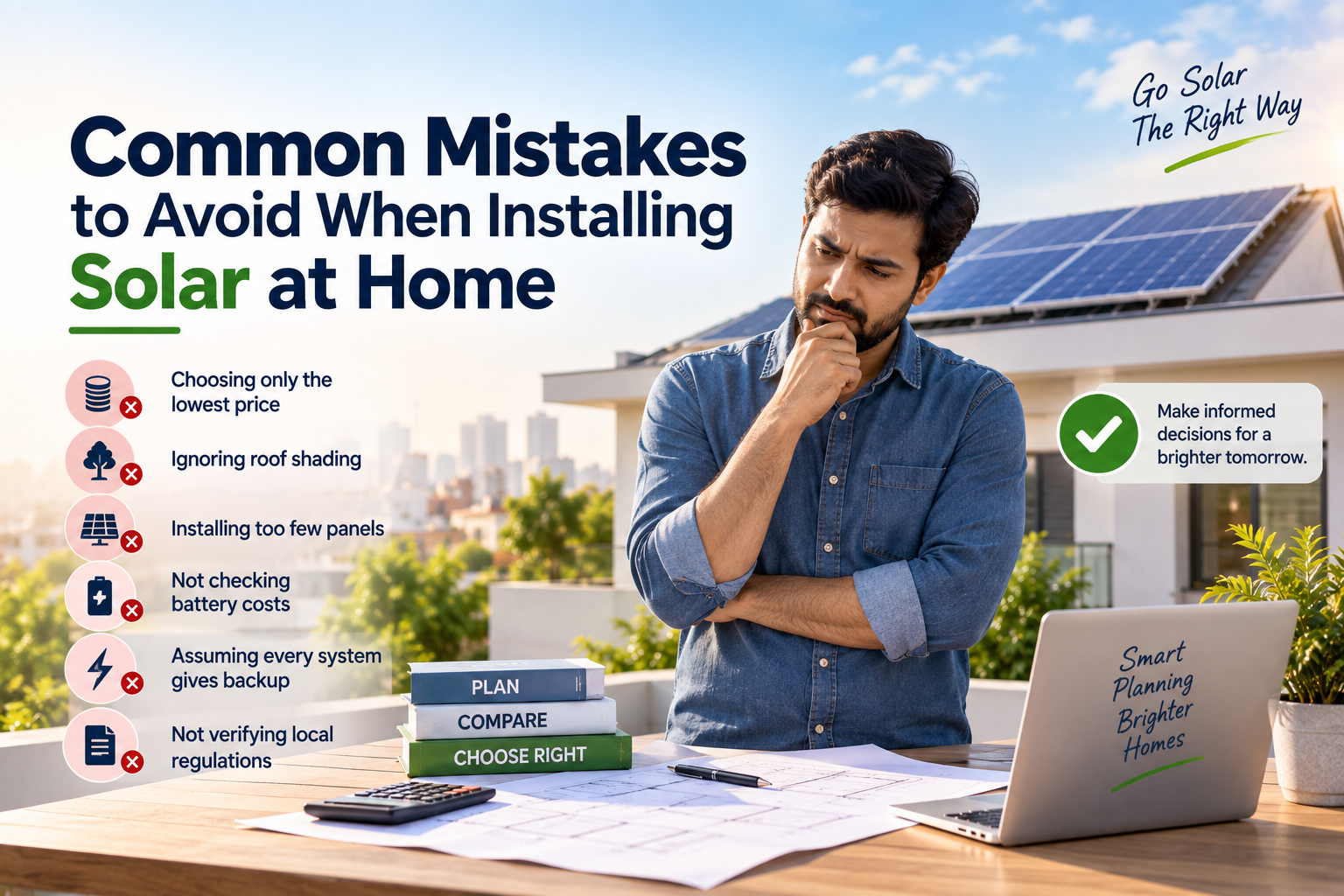
Choosing a solar system involves more than comparing panel capacity and installation prices. Avoid these common mistakes to improve long-term performance and value.
1. Choosing the Cheapest Quotation
The lowest price may not offer the best value. Compare panel and inverter specifications, warranties, electrical safety, installation quality, monitoring, and after-sales support before choosing an installer.
2. Installing Too Few Panels
An undersized system may not deliver the expected electricity savings. Solar capacity should be based on actual electricity consumption, rooftop space, sunlight exposure, system design, and future energy needs.
3. Ignoring Shading
Trees, water tanks, and nearby buildings can reduce solar generation. A professional rooftop assessment should identify potential shading before installation.
4. Selecting an Inadequate Inverter
The inverter should match the solar array, system capacity, household loads, and selected system configuration. Check efficiency, monitoring, warranty, and battery compatibility if backup is required.
5. Ignoring Battery Costs
For systems with backup, consider the battery's capacity, lifespan, replacement cost, and maintenance requirements when calculating the total investment.
6. Assuming Every Solar System Provides Backup
A conventional on-grid system generally does not provide electricity during grid outages. If backup is required, discuss hybrid or battery-based solutions with the installer.
7. Not Checking Local Regulations
Grid-connected solar may require specific DISCOM procedures, metering, documentation, approvals, and government scheme requirements. Always verify the latest local requirements before installation.
Read more: How to Choose the Right Size Solar System for Your Home in India?
Which Solar System Is Best for Your Home?
The right solar system depends on your electricity usage, grid reliability, budget, and whether you need backup power during outages. Use this simple guide to identify the most suitable option:
| Your Priority | Recommended System | Why? |
|---|---|---|
| Reduce electricity bills | On-Grid Solar | Uses the grid connection and can reduce electricity costs through solar generation and applicable net-metering arrangements. |
| Reliable backup during power cuts | Hybrid Solar | Combines solar generation with battery storage and grid connectivity to provide backup for selected loads. |
| Maximum energy independence | Off-Grid Solar | Operates independently of the utility grid and uses batteries to store solar energy. |
| Solar savings + power backup | Hybrid Solar | Provides a balance between reducing grid electricity consumption and maintaining backup power. |
| Remote property with limited/no grid access | Off-Grid Solar | Designed to operate without depending on a conventional grid connection. |
| Home with a stable grid and no major backup requirement | On-Grid Solar | Usually offers a simpler configuration focused on reducing electricity bills. |
Quick Decision Guide
Choose On-Grid Solar if:
- Your home has a reasonably reliable electricity connection.
- Your main goal is reducing electricity bills.
- You do not require battery backup.
Choose Off-Grid Solar if:
- Grid electricity is unavailable or highly unreliable.
- You need greater energy independence.
- You are prepared for the higher upfront cost of battery storage.
Choose Hybrid Solar if:
- You want to reduce electricity bills.
- You also need backup during power cuts.
- You want flexibility between solar, battery, and grid power.
Read more: How Much Subsidy Can You Get on Rooftop Solar in Rajasthan?
How to Choose the Right Solar Installer in Jaipur
If you are exploring solar solutions in India or planning residential rooftop solar in Jaipur, compare installers using a clear checklist.
Look for an installer that provides:
- Site Assessment: Evaluation of your rooftop, shading, electricity usage, and structural conditions.
- System Design: Clear recommendations for system capacity and configuration.
- Quality Equipment: Complete specifications for panels, inverter, batteries, mounting structure, and safety components.
- Transparent Pricing: A quotation that clearly explains included and excluded services.
- Installation Expertise: Proper installation is essential for system performance and safety.
- Warranty Support: Clear equipment and workmanship warranty terms.
- After-Sales Service: Support for monitoring, maintenance, troubleshooting, and repairs.
- Regulatory Assistance: Help with applicable DISCOM, metering, and government scheme procedures for grid-connected systems.
Choose EGPS for Residential Solar Installation in Jaipur
Planning to install solar at your home? EGPS provides residential solar panel installation solutions designed around your electricity consumption, rooftop conditions, and energy requirements.
From site assessment and system design to installation and ongoing support, our team can help you choose a suitable solar solution for your home.
Conclusion
For most homes with a reliable electricity connection, on-grid solar is generally the first option to consider for reducing electricity bills. Off-grid solar may be more suitable for remote properties or homes where independent power and battery backup are essential. For homeowners who want solar savings while maintaining backup during power cuts, a hybrid system may provide a practical middle ground.
The right choice depends on electricity consumption, rooftop conditions, budget, grid reliability, and backup requirements. A professional site assessment can help determine the appropriate system capacity and configuration for your home.
If you are planning solar system installation for your home, getting a professional assessment before choosing the system can help ensure that the solution is designed around your property's actual energy needs and rooftop conditions.
Frequently Asked Questions
1. Which is better for a home: on-grid or off-grid solar?
An on-grid system is generally suitable for homes with reliable grid electricity that primarily want to reduce electricity bills. An off-grid system may be better for homes with unreliable or unavailable grid power and a greater need for energy independence.
2. Is an on-grid solar system suitable for homes in Jaipur?
Yes. On-grid solar can be a practical option for homes in Jaipur with suitable rooftops and grid connections. The final system design should consider electricity consumption, rooftop conditions, shading, and applicable DISCOM requirements.
3. Does an on-grid solar system work during a power cut?
A conventional on-grid solar system generally does not provide electricity during a grid outage. A hybrid or battery-based system is more suitable when backup power is required.
4. What is the difference between on-grid and off-grid solar systems?
An on-grid system remains connected to the electricity grid and is primarily designed to reduce grid electricity consumption. An off-grid system operates independently and uses batteries to store solar energy for use when sunlight is unavailable.
5. Is a battery required for an off-grid solar system?
Yes. Batteries are an essential part of a typical off-grid solar system because they store electricity for use at night and during periods of insufficient solar generation.
6. Is hybrid solar better than on-grid solar for homes?
A hybrid solar system may be better for homeowners who want both electricity bill savings and backup power. On-grid solar may be more suitable when the main priority is reducing electricity costs and the grid supply is reliable.
7. How much solar capacity does a home need?
The required solar capacity depends on factors such as monthly electricity consumption, daytime usage, rooftop space, sunlight exposure, system efficiency, and future electricity requirements. A professional site assessment can help determine the appropriate capacity.
8. How much does a solar system installation for a home cost?
The cost depends on system capacity, solar panels, inverter, mounting structure, battery requirements, installation work, electrical protection, and other project-specific requirements. On-grid systems are generally less expensive than systems that require substantial battery storage.
9. Is solar installation eligible for government subsidy in India?
Eligible residential rooftop solar systems may qualify for financial assistance under applicable government schemes, including PM Surya Ghar: Muft Bijli Yojana. Eligibility, system requirements, approved vendors, documentation, and DISCOM procedures apply, so homeowners should verify the latest rules before calculating the expected subsidy.
10. How do I choose the right solar installer in Jaipur?
Choose an installer that provides proper site assessment, system design, quality equipment, transparent pricing, professional installation, warranty support, after-sales service, and assistance with applicable DISCOM and government procedures.