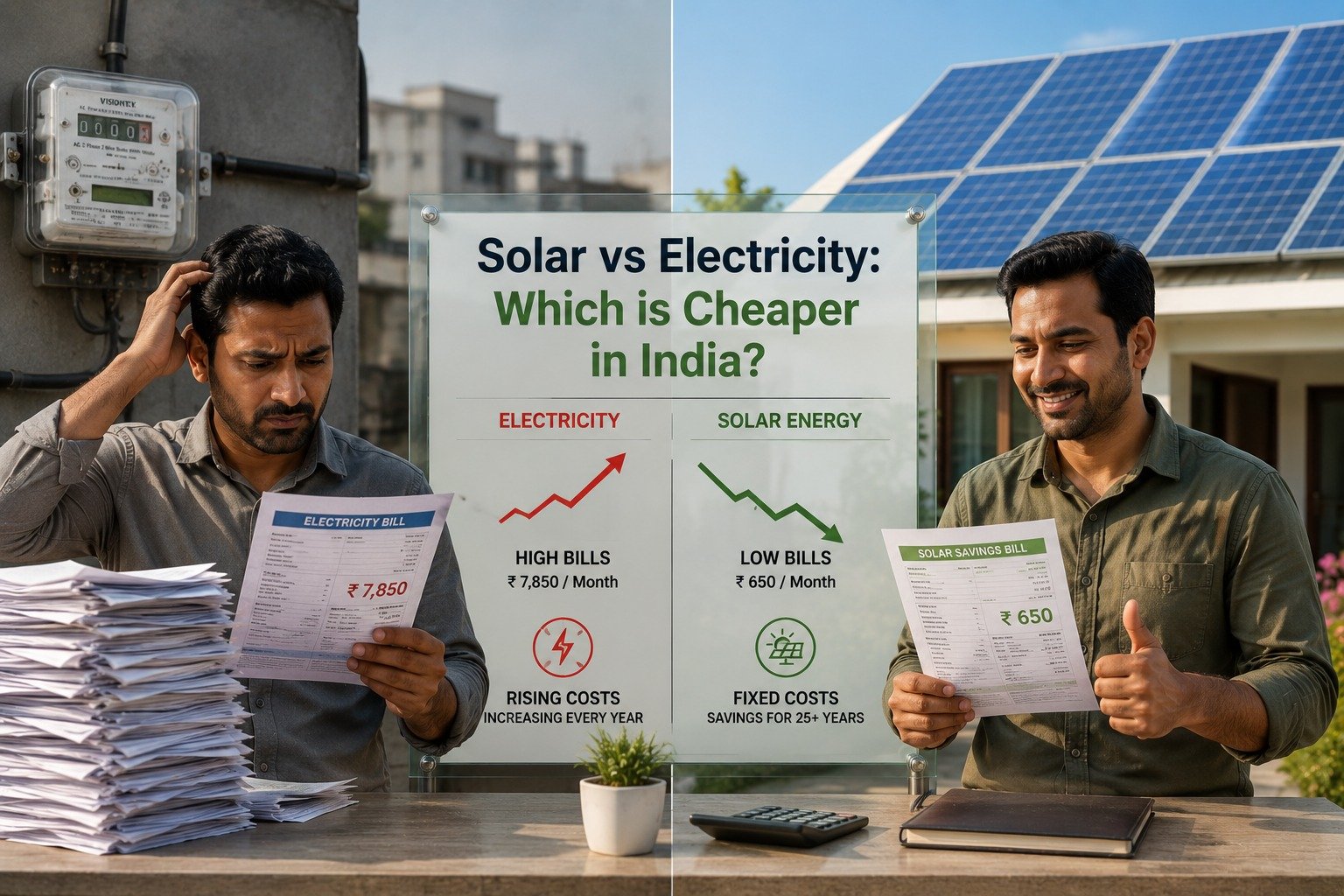
Solar vs Electricity: Which Is Cheaper in India?
Solar vs Electricity Cost in India (2026): Which Is Cheaper & Why?
What if you could reduce your electricity bill by up to 70%—or even eliminate it for decades?
With rising power demand, increasing fuel costs, fixed charges, and frequent tariff hikes, electricity bills are becoming a major financial burden for homeowners, businesses, factories, and commercial property owners across India. This growing pressure has led many to ask a simple but powerful question: is solar cheaper than normal electricity?
The answer isn't one-size-fits-all—it depends on your usage, location, system size, electricity tariff, and sunlight availability. However, for most long-term users, solar solutions offer significantly better savings compared to relying entirely on grid electricity. Once installed, a solar power system can generate electricity for 25 years or more, with minimal maintenance costs.
That's why more people are now shifting toward solar solutions in India—from homes and offices to factories, schools, hospitals, and warehouses. In cities like Jaipur, where sunlight is abundant throughout the year, installing a solar system in Jaipur can lead to substantial bill reductions and faster return on investment.
Of course, choosing the right solar solution company is just as important as deciding to go solar. A professional provider ensures proper system design, smooth solar installation, efficient solar commissioning, net metering support, and reliable long-term service.
In this detailed guide, we'll break down the real cost comparison between solar and electricity in India—and help you understand which option truly saves you more in the long run.
Is solar cheaper than electricity in India?
Yes, solar is cheaper than grid electricity in India in the long run. While grid power requires monthly payments, solar systems generate electricity for 25+ years after installation, reducing overall costs significantly.
Quick Benefits
- Lower long-term electricity costs
- Protection from tariff increases
- Reduced grid dependence
- 25+ years of energy generation
- Faster return on investment
- Government subsidy benefits
- Lower monthly bills
- Better long-term savings
Why Solar Solutions Are Cheaper Than Electricity in India
Electricity might seem cheaper at first because there's no upfront investment, but over time, it becomes one of the most expensive recurring costs for homes and businesses. This is where solar solutions clearly stand out as the more cost-effective option in India.
1. One-Time Investment vs Lifetime Payments
With grid electricity, you pay every month—and those costs never stop. With solar solutions, you invest once and generate power for 25+ years.
Think of it like this:
- Electricity = Renting energy forever
- Solar = Owning your power source
2. Rising Electricity Tariffs
Electricity prices in India increase regularly due to:
- Fuel cost hikes
- Infrastructure upgrades
- Government tariff revisions
Solar protects you from these increases because your cost is locked in at installation.
3. Major Long-Term Savings
Let's break it down with a simple example:
- Monthly electricity bill: $100
- After solar: $20
- Monthly savings: $80
- Yearly savings: $960
- 25-year savings: $24,000
This is why solar solutions are considered a long-term financial asset, not just an expense.
4. Free Energy from the Sun
Once installed, solar systems use sunlight—which is completely free.
- No fuel cost
- No price fluctuation
- No dependency on external suppliers
This dramatically reduces your cost per unit compared to grid electricity.
5. Net Metering Increases Savings
With net metering:
- Extra electricity is sent to the grid
- You earn credits on your bill
- Your total payable amount reduces further
This ensures zero wastage of generated energy.
6. Low Maintenance Costs
Solar systems require minimal maintenance:
- Occasional cleaning
- Basic inspections
Compared to rising electricity bills, maintenance costs are negligible.
7. Higher Savings in Cities Like Jaipur
In high-sunlight regions:
- Solar panels generate more electricity
- Faster return on investment (ROI)
- Greater bill reduction
This makes solar solutions especially profitable in cities like Jaipur and across Rajasthan.
Read more: How to Apply for a Solar Subsidy in India
Understanding Electricity Costs in India
Electricity costs in India vary by state, consumer category, monthly consumption, and connection type. Residential, commercial, and industrial users are charged differently. Businesses usually pay higher tariffs than households, making energy bills a major operating cost. Understanding these charges helps users compare grid electricity with solar solutions more clearly.
Key Cost Factors
- Residential tariffs
- Commercial tariffs
- Industrial tariffs
- Fuel adjustment charges
- Fixed charges
- Demand charges
- Future tariff increases
Example Electricity Rate Range in India
| Consumer Type | Example Tariff Range | Common Extra Charges |
|---|---|---|
| Residential | ₹4 to ₹9 per unit | Fixed charge, taxes |
| Commercial | ₹7 to ₹12 per unit | Demand charge, fixed charge |
| Industrial | ₹6 to ₹11 per unit | Demand charge, power factor charge |
| High-Usage Consumers | Higher slab rates | Surcharges and penalties |
Grid electricity is convenient because users receive power directly from the distribution company. However, the cost continues every month. As usage increases, many consumers move into higher tariff slabs.
For businesses and factories, electricity cost becomes even more important because power is required for machinery, lighting, cooling, pumps, motors, computers, and production systems.
Solar changes this model. Instead of only buying power every month, users generate their own electricity through a rooftop solar system or ground-mounted solar power system.
What Are Solar Solutions?
Solar solutions in India are complete systems that help homes and businesses generate electricity from sunlight. These include solar panels, inverters, mounting structures, wiring, net metering support, solar installation, and solar commissioning. A reliable solar energy company in Jaipur can design a system based on your electricity usage and roof space.
Solar Solutions Include
- Solar panel installation
- Rooftop solar system design
- Commercial solar projects
- Industrial solar systems
- Net metering assistance
- Solar commissioning
- Maintenance and monitoring
Main Components of a Solar System
| Component | Purpose |
|---|---|
| Solar Panels | Convert sunlight into DC electricity |
| Inverter | Converts DC electricity into AC electricity |
| Mounting Structure | Holds panels safely on roof or land |
| AC/DC Cables | Transfers electricity safely |
| Net Meter | Measures import and export of power |
| Monitoring System | Tracks energy generation |
Solar solutions are not just about installing panels. A good system must be properly designed, installed, tested, and commissioned. If the system size is too small, savings will be limited. If it is too large without proper net metering planning, energy may be wasted.
This is why choosing an experienced solar solution company matters. Proper engineering ensures better performance, higher savings, and safer operation.
How Solar Energy Works
Solar energy works by capturing sunlight through photovoltaic panels and converting it into usable electricity. The electricity generated during the day can be used directly by the home, shop, office, factory, or commercial building. Extra power can be exported to the grid through net metering where applicable.
How Solar Works
- Solar panels absorb sunlight
- Panels generate DC electricity
- An inverter converts DC into AC power
- Electricity is used by appliances and machines
- Extra power can go to the grid
- Net metering adjusts exported units
- Monthly electricity bills reduce
During daytime, solar panels generate electricity. This power first supports your current usage. For example, if your office is running lights, fans, computers, air conditioners, and equipment during the day, solar power can directly reduce grid consumption.
If the solar system generates more than your current requirement, the extra energy may be exported to the grid through net metering. This helps reduce future bills.
Solar is especially useful in Jaipur and Rajasthan because high sunlight availability improves generation and makes solar ROI more attractive.
Solar vs Electricity Cost Comparison in India
When comparing solar vs electricity, it is important to look beyond the initial cost. Grid electricity has a low upfront cost but continuous monthly bills. Solar has an upfront investment but delivers long-term savings. Over 25 years, solar is often much cheaper than relying only on grid power.
Quick Comparison Points
- Solar has higher initial cost but lower running cost
- Grid electricity has no installation cost but continuous bills
- Solar offers price stability
- Grid tariffs may increase over time
- Solar supports clean energy goals
- Solar improves long-term savings
Solar Energy vs Grid Electricity
| Parameter | Solar Energy | Grid Electricity |
|---|---|---|
| Initial Cost | Higher one-time investment | Low initial cost |
| Monthly Expenses | Low after installation | Regular monthly bills |
| Maintenance Cost | Low | Not applicable to consumer |
| Lifespan | 25+ years | Continuous dependency |
| Price Stability | High | Tariffs may increase |
| Long-Term Savings | Strong | Limited |
| Environmental Impact | Clean and renewable | It depends on power source |
| Best For | Long-term users | Short-term or low-use consumers |
Solar Installation Cost in India
The solar installation cost in India depends on system size, location, and component quality. On average:
- 2–3 kW system: $1,200 – $2,400
- 5 kW system: $3,000 – $5,000
- 10 kW system: $6,000 – $10,000
Although the initial investment may seem high, the long-term savings make solar one of the most cost-effective energy solutions.
Grid electricity is easier in the beginning because there is no installation investment. But users keep paying every month. Over many years, the total cost becomes much higher.
Solar works differently. You invest once and then generate electricity for decades. For people with high electricity bills, solar can recover its cost in a few years and continue saving money for the rest of its life.
For homes, shops, factories, and commercial buildings, solar becomes cheaper when viewed as a long-term energy investment.
Read more: How Much Does Solar Panel Installation Cost in Jaipur in 2026?
Solar vs Diesel Generator Cost
Many businesses and homes in India rely on diesel generators during power cuts—but they are far more expensive than solar in the long run.
Cost Comparison
| Factor | Solar Energy | Diesel Generator |
|---|---|---|
| Initial Cost | High (one-time) | Medium |
| Running Cost | Near zero | Very high (fuel) |
| Fuel Price | Free (sunlight) | Fluctuating diesel cost |
| Maintenance | Low | High |
| Lifespan | 25+ years | 5–10 years |
Example:
- Diesel cost per unit: ~$0.25 – $0.40
- Solar cost per unit: ~$0.03 – $0.06
Diesel generators are up to 5–8x more expensive per unit than solar.
Solar Payback Period in India (ROI in Years)
The payback period is the time required to recover your solar investment through electricity bill savings. In India, most solar systems recover their cost within 3 to 6 years, depending on usage and location.
Typical ROI:
- Residential systems: 4–6 years
- Commercial systems: 3–5 years
- Industrial systems: 2–4 years
After this period, electricity is essentially free for the remaining life of the system (20+ years).
In cities like Jaipur, higher sunlight reduces the payback period further.
Government Subsidy on Solar in Rajasthan
The Indian government provides subsidies for residential rooftop solar systems under national and state schemes.
Key Benefits:
- Up to 40% subsidy for small residential systems
- Reduced upfront cost
- Faster return on investment
- Encourages clean energy adoption
Subsidy availability depends on system size and current government policies. A professional solar solution company can help with subsidy application and approvals.
Read more: What Documents Are Required for Solar Subsidy in Rajasthan?
Net Metering Explained in Simple Terms
Net metering allows you to send extra solar electricity back to the grid and receive credits on your electricity bill.
How It Works:
- Your solar system generates electricity during the day
- You use what you need
- Extra electricity is exported to the grid
- The meter records exported units
- These units reduce your future electricity bill
This system helps maximize savings and ensures no solar energy is wasted.
Solar Battery vs Grid Electricity
Solar systems can work with or without batteries.
Comparison
| Feature | Solar + Battery | Grid-Tied Solar |
|---|---|---|
| Power Backup | Yes | No |
| Cost | Higher | Lower |
| ROI | Slightly longer | Faster |
| Independence | High | Medium |
| Maintenance | Moderate | Low |
When to Choose Battery:
- Frequent power cuts
- Need backup power
- Off-grid or rural areas
Pro Tip: For most urban users, grid-tied solar + net metering is more cost-effective.
How Much Can You Save with Solar?
Solar savings depend on system size, electricity tariff, sunlight availability, and daily consumption pattern. Users with high daytime electricity usage usually save more. Homes, commercial buildings, and factories can all benefit, but savings are highest when solar generation matches actual power consumption.
Main Savings Factors
- Monthly electricity bill amount
- Solar system capacity
- Available roof area
- Quality of installation
- Net metering approval
- Local electricity tariff
- Usage during daytime
Small Home
A small home with a 2 kW to 3 kW rooftop solar system can reduce monthly electricity bills significantly. Depending on usage and net metering, annual savings may range from ₹20,000 to ₹45,000.
Large Home
A larger home with higher appliance use may install a 5 kW to 10 kW system. Annual savings can often range from ₹50,000 to ₹120,000 depending on electricity consumption.
Commercial Building
A commercial building with daytime usage can achieve strong savings because solar power generation matches office and business hours. Annual savings may range from ₹1 lakh to several lakhs.
Factory
Factories and industrial units can save significantly with larger solar systems. Depending on electricity load, solar can reduce annual electricity costs by lakhs or even more.
Read more: How Solar Reduces Business Electricity Bills in India
Estimated Savings Table
| User Type | Example System Size | Estimated Bill Reduction |
|---|---|---|
| Small Home | 2-3 kW | 40% to 70% |
| Large Home | 5-10 kW | 50% to 80% |
| Commercial Building | 20-100 kW | 40% to 75% |
| Factory | 100 kW+ | 30% to 70% |
How Much Can You Save with Solar?
Real Example (Jaipur Home):
A Jaipur home with a ₹8,000 monthly electricity bill installs a solar system. After installation, the bill drops to around ₹1,500 per month.
- Monthly savings: ₹6,500
- Annual savings: ₹78,000
- Over 25 years: ₹19+ lakhs saved
Want to know your exact savings? Get a free solar estimate today.
Factors That Affect Solar Savings
Solar savings are not the same for every user. Two homes with the same system size may get different results due to roof direction, shadow, electricity usage, panel quality, and net metering policy. Understanding these factors helps in choosing the right solar solutions for maximum electricity bill savings.
Key Factors
- System size
- Location
- Sunlight availability
- Energy consumption
- Net metering policy
- Roof direction
- Panel quality
- Installation quality
Location plays a major role in solar output. Jaipur and many parts of Rajasthan receive strong sunlight for most of the year, making solar energy benefits more attractive.
System size also matters. A properly sized system should match your electricity consumption pattern. Oversized systems may cost more, while undersized systems may not reduce bills enough.
Net metering is another important factor. It allows users to export extra solar energy and receive bill adjustments as per applicable policy.
Solar Maintenance Cost Breakdown
Solar systems are known for low maintenance costs, making them highly economical.
Typical Maintenance
| Activity | Frequency | Cost |
|---|---|---|
| Panel Cleaning | 1–2 times/month | Minimal |
| Inspection | Yearly | Low |
| Inverter Replacement | 8–12 years | Moderate |
Annual Cost Estimate:
- Residential system: ~$15 – $50/year
- Commercial system: Slightly higher
Key Insight: Maintenance cost is less than 1% of total system cost annually.
Why Solar Is Becoming More Affordable in India
Solar has become more affordable in India due to better technology, competitive pricing, growing adoption, government support, and improved installation standards. Earlier, solar was considered expensive, but today it is a practical investment for homeowners, businesses, factories, and property owners looking for long-term savings.
Reasons Solar Is More Affordable
- Lower panel prices
- Government support
- Better technology
- Increased adoption
- Improved efficiency
- More trained installers
- Better financing options
Solar technology has improved rapidly. Modern panels generate more electricity in less space and come with long performance warranties. Inverters and monitoring systems have also become more reliable.
As demand has grown across India, installation costs have become more competitive. More users now understand that solar should not be judged only by upfront cost. The real value comes from long-term electricity bill savings.
For high-consumption users, solar often becomes one of the best renewable energy solutions available today.
Benefits of Installing a Solar System in Jaipur
Jaipur is one of the most suitable cities for solar installation because of strong sunlight availability, growing electricity demand, and increasing awareness about renewable energy. A well-designed solar system in Jaipur can reduce monthly bills, improve energy independence, and deliver faster ROI for homes and businesses.
Jaipur Solar Benefits
- High solar radiation
- More sunny days
- Faster ROI
- Reduced electricity bills
- Long-term savings
- Suitable rooftop conditions
- Strong demand for clean energy
Rajasthan has excellent solar potential, and Jaipur is a strong market for rooftop solar systems. Homes, schools, hotels, offices, showrooms, hospitals, and commercial buildings can all benefit from solar.
A professional solar energy company in Jaipur can assess your roof, electricity bill, shadow conditions, and system requirements before recommending the right solution.
With proper solar installation and solar commissioning, users can enjoy safe operation, strong generation, and long-term savings.
Best Solar Solutions in Jaipur for Homes & Businesses
If you are looking for the best solar company in Jaipur, it is important to choose a provider that offers complete services—from design to solar panel installation in Jaipur and long-term support. A professional company ensures maximum efficiency, proper system sizing, and faster ROI.
Top Solar Energy Company in Jaipur
Choosing the right solar energy company in Jaipur is critical for system performance, safety, and long-term savings.
What to Look For:
- Experience in residential & commercial projects
- End-to-end services (design, installation, commissioning)
- Net metering support
- Strong customer support
- High-quality components
A trusted provider ensures your solar investment delivers maximum ROI and reliable performance for decades.
Residential vs Commercial Solar Savings
Residential and commercial solar systems both reduce electricity bills, but their savings pattern is different. Homes usually focus on monthly bill reduction, while businesses focus on operating cost control, ROI, and long-term profitability. Commercial solar systems are often larger and can deliver faster payback due to higher tariffs.
Quick Comparison
- Residential solar reduces household bills
- Commercial solar reduces business operating costs
- Commercial systems are usually larger
- ROI depends on electricity tariff and usage
- Both require quality installation and maintenance
Residential Solar vs Commercial Solar
| Factor | Residential Solar | Commercial Solar |
|---|---|---|
| Investment | Lower | Higher |
| Energy Generation | Small to medium | Medium to large |
| Savings | Monthly bill reduction | Operating cost reduction |
| ROI | Good | Often faster |
| Maintenance | Simple | More structured |
| Best For | Homes, villas, societies | Shops, offices, factories, schools |
Residential users usually install solar to reduce home electricity bills and gain long-term savings. Commercial users install solar to reduce recurring business expenses.
For businesses, even a small percentage reduction in electricity cost can improve profitability. This is why commercial solar and industrial solar adoption are growing across India.
Why Businesses Are Switching to Solar Solutions India
Businesses across India are switching to solar because electricity is a major recurring cost. Solar Solutions India helps companies reduce operating expenses, improve energy independence, meet sustainability goals, and strengthen brand value. For commercial and industrial users, solar is no longer optional—it is becoming a smart business decision.
Business Benefits
- Lower operating costs
- Sustainability goals
- Energy independence
- Competitive advantage
- ESG compliance
- Better cost control
- Long-term financial savings
Factories, warehouses, hotels, hospitals, malls, schools, and offices consume large amounts of electricity. Solar helps them generate power on-site and reduce dependence on expensive grid electricity.
Businesses also gain reputational value by using renewable energy solutions. Many customers and investors now prefer companies that take sustainability seriously.
For industrial units, solar helps improve cost predictability. Instead of worrying about future tariff increases, businesses can lock in long-term energy savings.
Read more: Which Solar System is Best for Home Use in 2026?
How to Choose the Right Solar Solution Company
Choosing the right solar solution company is critical because system performance depends on design, equipment quality, installation safety, and commissioning accuracy. A low-cost installation may look attractive initially, but poor workmanship can reduce generation, increase maintenance issues, and affect long-term savings.
Selection Checklist
- Experience
- Certifications
- Installation quality
- Warranty support
- Service network
- Customer reviews
- Engineering capability
- Net metering knowledge
A trusted solar solution company should begin with a proper site survey and energy analysis. It should explain system size, expected generation, payback period, equipment warranty, and service support clearly.
The company should also provide professional solar commissioning after installation. Commissioning ensures that the system is safe, properly connected, and performing as designed.
For Jaipur and Rajasthan users, local experience is valuable because the installer understands weather, roof structures, DISCOM processes, and net metering requirements.
Why Choose EGPS for Solar Installation & Commissioning?
EGPS provides professional solar installation and commissioning support for residential, commercial, and industrial users. The company focuses on quality engineering, reliable system design, safe installation, and long-term service assistance. For anyone looking for reliable solar solutions in Rajasthan, EGPS offers end-to-end support from consultation to commissioning.
Why Choose EGPS?
- Expert engineering team
- High-quality installations
- Residential and commercial expertise
- End-to-end project management
- Professional commissioning support
- Long-term service assistance
- Net metering guidance
- Customized solar power system design
EGPS helps users choose the right solar power system based on electricity bills, roof area, budget, and long-term savings goals. The team handles technical planning, installation quality, safety checks, commissioning, and support.
Whether you need a rooftop solar system for your home or solar solutions for a commercial building, EGPS provides practical and performance-focused guidance.
Conclusion
When comparing solar vs electricity in India, solar clearly offers stronger long-term value for most high-use consumers. Grid electricity may seem easier because there is no upfront investment, but it creates continuous monthly expenses and exposure to tariff increases.
Solar works differently. A well-designed solar power system generates electricity for 25 years or more, reduces monthly bills, supports net metering, and improves long-term savings. For homes, commercial buildings, factories, schools, hospitals, and property owners, solar is not just an energy choice—it is a financial decision.
Installing a solar system in Jaipur is especially beneficial because the region receives strong sunlight for most of the year. This improves energy generation and supports faster ROI.
However, results depend heavily on choosing the right solar solution company. Poor installation can reduce savings, while expert installation and commissioning can maximize performance.
Choosing the right solar solutions provider ensures maximum savings and long-term performance. If you want dependable solar solutions, professional solar installation, and long-term electricity bill savings,EGPS can help you make the right decision. Talk to a solar expert in Jaipur and reduce your electricity bill by up to 70%.
Frequently Asked Questions
1. Is solar cheaper than electricity in India?
Yes, solar is cheaper in the long run. While electricity requires ongoing monthly payments, solar involves a one-time investment and provides free power for 25+ years, making it significantly more cost-effective.
2. How much money can solar save annually?
Annual solar savings depend on system size, electricity tariff, usage pattern, and location. A small home may save ₹20,000 to ₹45,000 per year, while a larger home or commercial building may save much more. Factories and industrial units can save lakhs annually with properly designed solar solutions and net metering benefits.
3. What is the lifespan of a solar system?
Most solar power systems last 25 years or more. Solar panels usually come with long performance warranties, while inverters may need replacement earlier depending on usage and quality. With proper installation, regular maintenance, and timely inspection, a rooftop solar system can provide reliable electricity generation for decades.
4. Does solar completely eliminate electricity bills?
Solar can significantly reduce electricity bills, but it may not always eliminate them completely. Users may still pay fixed charges, meter charges, or grid-related fees. If system size, net metering, and consumption are properly planned, many users can reduce their monthly electricity bills by a large percentage.
5. Is a solar system in Jaipur a good investment?
Yes, a solar system in Jaipur is a strong investment because Jaipur receives good sunlight for most of the year. This supports higher solar generation and faster return on investment. Homes, shops, offices, hotels, schools, and commercial buildings in Jaipur can benefit from reduced electricity bills and long-term savings.
6. What factors affect solar savings?
Solar savings depend on system size, roof direction, sunlight availability, electricity tariff, daily consumption, panel quality, inverter efficiency, and net metering policy. Installation quality also matters. A professionally designed system from a trusted solar solution company can generate better savings and perform more reliably over time.
7. How does net metering help reduce electricity bills?
Net metering allows solar users to export extra electricity to the grid and receive bill adjustments as per applicable policy. During the day, solar power is used first. If generation is higher than consumption, extra units go to the grid. These exported units help reduce future electricity bills.
8. Why are solar solutions becoming popular in India?
Solar solutions are becoming popular in India because electricity costs are rising, solar equipment is more affordable, technology is improving, and users want cleaner energy. Homes and businesses are also realizing that solar offers long-term electricity bill savings, energy independence, and environmental benefits.
9. How do I choose the right solar solution company?
Choose a solar solution company with proven experience, good installation quality, reliable equipment, warranty support, customer reviews, engineering expertise, and net metering knowledge. The company should provide a proper site survey, savings estimate, system design, installation, commissioning, and after-sales service.
10. Why choose EGPS for solar installation and commissioning?
EGPS provides expert solar installation and commissioning services for homes, businesses, and industrial users. The team supports system design, project execution, safety checks, net metering guidance, and long-term service assistance. EGPS focuses on quality, performance, and dependable solar solutions for users across Rajasthan.