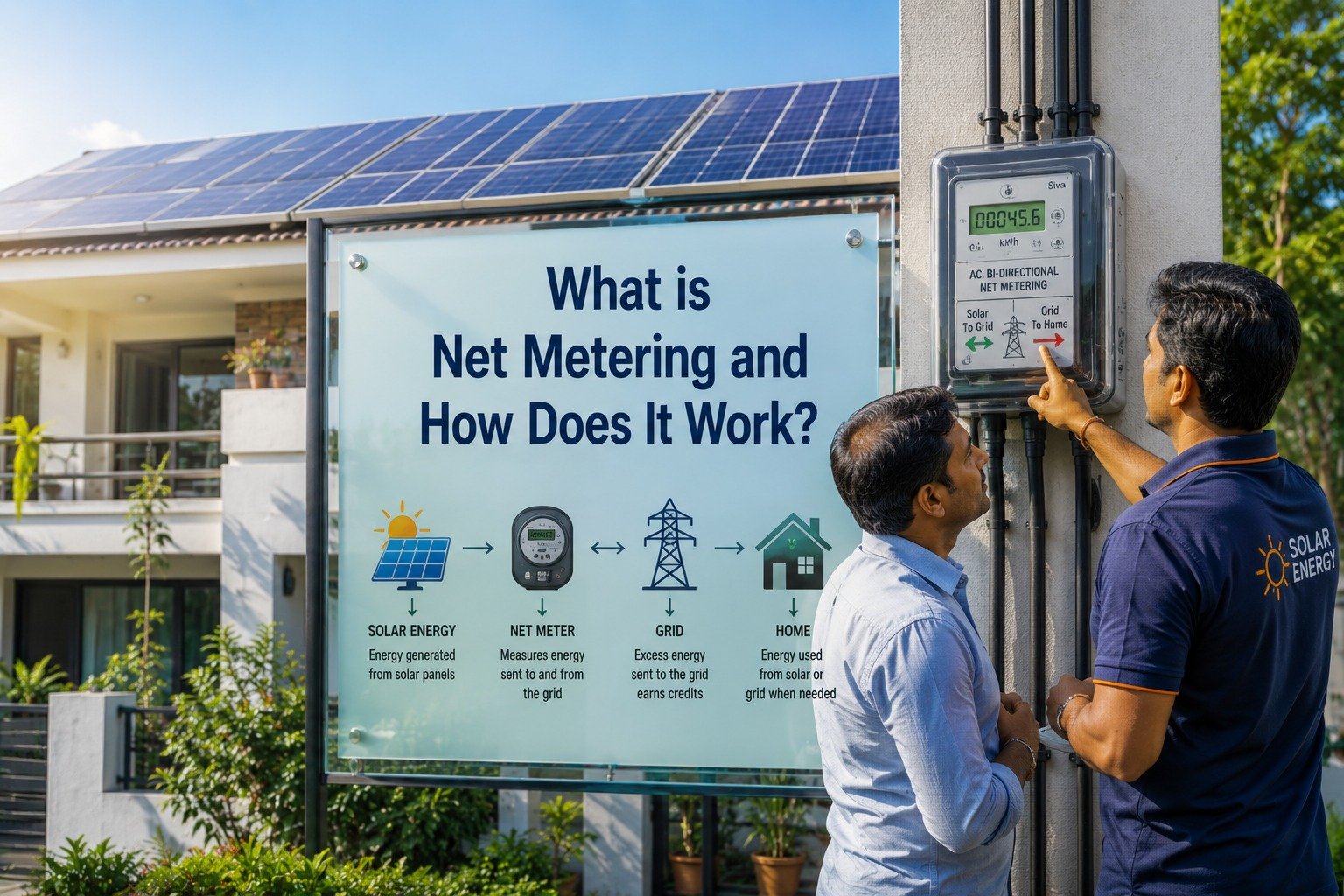
What is Net Metering and How Does It Work?
Electricity bills rising every month? What if your roof could start earning for you instead?
India is rapidly embracing rooftop solar as homeowners, businesses, schools, hospitals, and factories look for smarter ways to cut electricity costs and gain energy independence. With power tariffs climbing and awareness of renewable energy growing, solar is no longer just an eco-friendly choice—it's a financially savvy investment.
But here's the catch: installing solar panels is only half the story. To truly unlock maximum savings and boost your return on investment, you need to understand a powerful concept—net metering. This system allows you to send excess electricity back to the grid and earn credits that reduce your future bills, turning unused energy into real savings.
Net metering is the backbone of cost-effective solar adoption in India. It works hand-in-hand with the rooftop solar subsidy scheme and other government initiatives, making solar more accessible and rewarding than ever. Whether you're a homeowner planning to go solar or a business exploring solar solutions in India, understanding this mechanism can help you make smarter, more profitable decisions.
And the best part? With guidance from an experienced solar solution company or a reliable solar energy company in Jaipur, the entire process—from approvals to savings—becomes smooth, fast, and hassle-free.
What is net metering and how does it work?
Net metering in solar solutions in India is a billing system where excess electricity generated by rooftop solar panels is exported to the grid. A bidirectional meter tracks usage and credits surplus energy, reducing electricity bills and improving ROI.
Quick Benefits
- Measures electricity imported and exported
- Allows excess solar power to be sent to the grid
- Provides electricity bill credits
- Reduces monthly electricity costs
- Improves solar ROI
- Supports renewable energy adoption
- Essential for grid-connected solar systems
- Works through a bidirectional meter
What is Net Metering?
Net metering is one of the most important components of a grid-connected solar power system. It allows consumers to receive credit for surplus electricity generated by their solar installation. This mechanism helps maximize solar utilization and improve long-term financial benefits.
Key Highlights
- Definition of net metering
- Purpose of the system
- Benefits for solar users
- Connection with rooftop solar systems
- Importance in India
Net metering is a billing arrangement between electricity consumers and utility providers. Instead of wasting extra solar energy produced during sunny periods, users can export surplus power to the grid.
When electricity consumption exceeds solar generation, consumers draw power from the grid as usual. The net meter calculates the difference between imported and exported electricity, helping determine the final bill.
As solar adoption grows across India, net metering has become a key factor in improving electricity bill savings. With India aiming for 500 GW of renewable capacity by 2030, policies like net metering play a crucial role in accelerating rooftop solar adoption.
How Does Net Metering Work?
Net metering works by tracking electricity flowing in both directions between a consumer's solar power system and the utility grid. This ensures that excess solar generation receives appropriate credit.
Main Steps
- Solar power generation
- Electricity consumption
- Excess power export
- Grid interaction
- Credit adjustment
Process Flow Table
| Step | Activity | Result |
|---|---|---|
| 1 | Solar panels generate electricity | Power produced |
| 2 | Electricity is consumed on-site | Reduces grid usage |
| 3 | Excess energy exported | Sent to utility grid |
| 4 | Bidirectional meter records export | Credit accumulated |
| 5 | The grid supplies power when needed | Continuous supply |
| 6 | The utility calculates net usage | Final bill generated |
During daylight hours, solar panels generate electricity. This power is first used by the property. If generation exceeds consumption, surplus electricity is automatically exported to the grid.
Later, when solar generation decreases, electricity can be imported from the grid. The net meter records both activities and calculates the net energy balance.
This process significantly reduces electricity costs and enhances solar system economics.
Read more: How Much Does Solar Panel Installation Cost in Jaipur in 2026?
What Is a Net Meter?
A net meter, often called a bidirectional meter, is a specialized electricity meter that measures both imported and exported energy. It is a mandatory component of most grid-connected rooftop solar systems.
Key Functions
- Bidirectional measurement
- Import reading
- Export reading
- Energy tracking
- Billing calculation
Traditional electricity meters only measure incoming electricity. A bidirectional meter measures electricity moving in both directions.
This enables utilities to accurately track how much solar power has been exported and how much grid power has been consumed. These readings are then used to determine credits and billing adjustments.
Without a net meter, consumers cannot fully benefit from excess solar generation.
Benefits of Net Metering for Homeowners and Businesses
Net metering provides substantial financial and operational advantages for residential, commercial, and industrial consumers. It ensures maximum utilization of solar-generated electricity while improving overall system returns.
Major Benefits
- Lower electricity bills
- Faster ROI
- Better solar utilization
- Reduced grid dependence
- Long-term savings
Benefits Table
| Benefit | Impact |
|---|---|
| Bill Reduction | Lower monthly costs |
| Better Solar Usage | Less wasted energy |
| Improved ROI | Faster payback period |
| Grid Support | Balanced energy flow |
| Sustainability | Increased renewable energy use |
Homeowners benefit through lower household electricity expenses, while businesses can significantly reduce operating costs.
Net metering also encourages renewable energy adoption by making solar investments more financially rewarding.
How Net Metering Helps Reduce Electricity Bills
One of the biggest reasons people install solar systems is to lower electricity expenses. Net metering strengthens these savings by ensuring surplus energy remains valuable.
Key Savings Mechanisms
- Daytime solar generation
- Exporting excess energy
- Bill credit mechanism
- Monthly savings
- Long-term financial benefits
Practical Example
Suppose a home generates 500 units of solar electricity in a month but consumes only 400 units during daylight hours.
The extra 100 units are exported to the grid and recorded by the bidirectional meter. These units are then credited against future electricity consumption, reducing the final utility bill.
Instead of wasting unused solar power, net metering converts surplus energy into measurable financial value.
This improves overall solar performance and shortens payback periods.
Net Metering vs Gross Metering
Although both systems involve solar energy and grid interaction, they operate differently and produce different financial outcomes.
Comparison Table
| Parameter | Net Metering | Gross Metering |
|---|---|---|
| Energy Usage | Self-consumption first | All power exported |
| Billing Method | Net energy balance | Separate purchase/sale |
| Savings Potential | Higher | Moderate |
| Consumer Benefits | Better bill reduction | Revenue-based |
| ROI | Faster | Slower |
Net metering prioritizes self-consumption, which generally delivers greater savings because consumers avoid purchasing electricity at retail rates.
Gross metering exports all generated power and compensates consumers separately, often resulting in lower financial returns.
Read more: How Solar Reduces Business Electricity Bills in India
Who Is Eligible for Net Metering in India?
Net metering is available to a wide range of electricity consumers, depending on local regulations and utility policies.
Eligible Consumers
- Residential consumers
- Commercial buildings
- Industrial facilities
- Educational institutions
- Healthcare facilities
Most consumers installing approved grid-connected solar systems can apply for net metering.
Eligibility requirements may vary by state and distribution company, so applicants should verify current regulations before proceeding.
Documents Required for Net Metering Approval
Proper documentation is essential for successful net metering approval. Missing or incorrect paperwork is one of the most common causes of delays.
Required Documents
- Aadhaar Card
- PAN Card
- Electricity Bill
- Property Ownership Documents
- Solar Installation Details
- Application Forms
Document Checklist
| Document | Purpose |
|---|---|
| Aadhaar Card | Identity verification |
| PAN Card | Financial verification |
| Electricity Bill | Consumer validation |
| Ownership Documents | Property verification |
| Solar System Details | Technical approval |
| Application Form | Official submission |
Applicants should ensure all records are accurate and updated. Consistency between documents helps speed up verification and approval.
Read more: How to Apply for a Solar Subsidy in India
Step-by-Step Net Metering Application Process
The approval process involves several stages designed to ensure technical compliance and safe grid integration.
Application Steps
- System assessment
- Solar installation
- Application submission
- Document verification
- Site inspection
- Meter installation
- Approval and activation
After installing the solar system, applicants submit documentation to the utility provider.
Authorities verify technical specifications, conduct inspections, and install the bidirectional meter before granting final approval.
How Net Metering Supports the Rooftop Solar Subsidy Scheme
With India targeting 500 GW of renewable energy capacity by 2030, initiatives like the rooftop solar subsidy scheme and net metering are essential to drive mass adoption and make solar affordable. Net metering and the rooftop solar subsidy scheme work together to improve solar adoption and financial returns.
Key Contributions
- Eligibility support
- Better solar economics
- Increased savings
- Faster ROI
- Government renewable energy goals
The rooftop solar subsidy scheme helps reduce installation costs, while net metering increases long-term savings through bill credits.
Together, these mechanisms make solar more affordable and attractive for homeowners and businesses.
Want to apply for net metering without delays? Get expert assistance from our team.
Common Challenges in Net Metering Approval
Although the process is straightforward, some applicants encounter delays due to documentation and compliance issues.
Common Problems
- Documentation errors
- Delayed approvals
- Technical compliance issues
- Utility coordination
- Incomplete applications
Carefully reviewing paperwork before submission can help avoid unnecessary delays.
Professional assistance often simplifies approval and improves processing timelines.
Role of a Solar Solution Company in Net Metering
Managing net metering independently can be challenging, especially for first-time solar users. Professional support helps streamline the process.
Services Provided
- Documentation assistance
- Application management
- Utility coordination
- Technical compliance
- Faster approvals
An experienced solar solution company handles administrative and technical requirements, helping consumers avoid common mistakes.
This support often leads to faster approvals and smoother project execution.
Why Choose EGPS for Net Metering & Subsidy Assistance?
Net metering and subsidy applications require careful coordination, accurate documentation, and compliance with utility requirements. EGPS helps simplify every step.
Why EGPS?
- End-to-end support
- Documentation guidance
- Application management
- Net metering expertise
- Subsidy assistance
- Professional service
EGPS provides complete support for solar installation, net metering approvals, and solar subsidy applications.
Its experienced team assists with paperwork, inspections, utility coordination, and compliance management to ensure a smoother approval experience.
Read more: What Documents Are Required for Solar Subsidy in Rajasthan?
Conclusion
Net metering is one of the most valuable features of a grid-connected rooftop solar system. It enables homeowners, businesses, schools, hospitals, and commercial property owners to maximize solar energy usage and reduce electricity costs through bill credits.
By allowing surplus electricity to be exported to the grid, net metering improves solar economics, shortens payback periods, and increases long-term savings. Combined with the rooftop solar subsidy scheme, it makes solar adoption more affordable and financially rewarding.
However, successful net metering approval requires accurate documentation, technical compliance, and proper coordination with utility providers. Working with an experienced solar solution company can simplify the process and help avoid common delays.
If you are planning a solar installation and want professional support with net metering and subsidy applications,EGPS provides expert guidance and end-to-end assistance to help you maximize your solar investment.
Start saving on electricity bills today—get expert net metering assistance with zero hassle.
Frequently Asked Questions
1. What is net metering in solar energy?
Net metering is a billing mechanism that allows solar users to export excess electricity to the utility grid and receive credits against future electricity consumption.
2. How does net metering reduce electricity bills?
It reduces bills by crediting exported solar energy, lowering the amount of electricity consumers need to purchase from the utility provider.
3. Who is eligible for net metering in India?
Residential, commercial, industrial, educational, and healthcare consumers with approved grid-connected solar systems may be eligible.
4. What documents are required for net metering approval?
Typically, Aadhaar Card, PAN Card, electricity bill, ownership documents, solar installation details, and completed application forms are required.
5. Is net metering mandatory for rooftop solar systems?
While not mandatory for all systems, it is highly recommended because it significantly improves solar savings and system economics.
6. What is the difference between net metering and gross metering?
Net metering credits surplus energy against consumption, while gross metering exports all generated power separately.
7. How long does net metering approval take?
Approval timelines vary depending on utility requirements, documentation accuracy, and inspection schedules.
8. How does net metering support the rooftop solar subsidy scheme?
It improves solar economics, increases savings, and helps consumers maximize the value of subsidized solar systems.
9. Why should I hire a solar solution company for net metering assistance?
Professional companies simplify documentation, ensure compliance, coordinate with utilities, and reduce approval delays.
10. Why choose EGPS for net metering and subsidy support?
EGPS provides complete assistance for documentation, approvals, inspections, subsidy applications, and utility coordination.