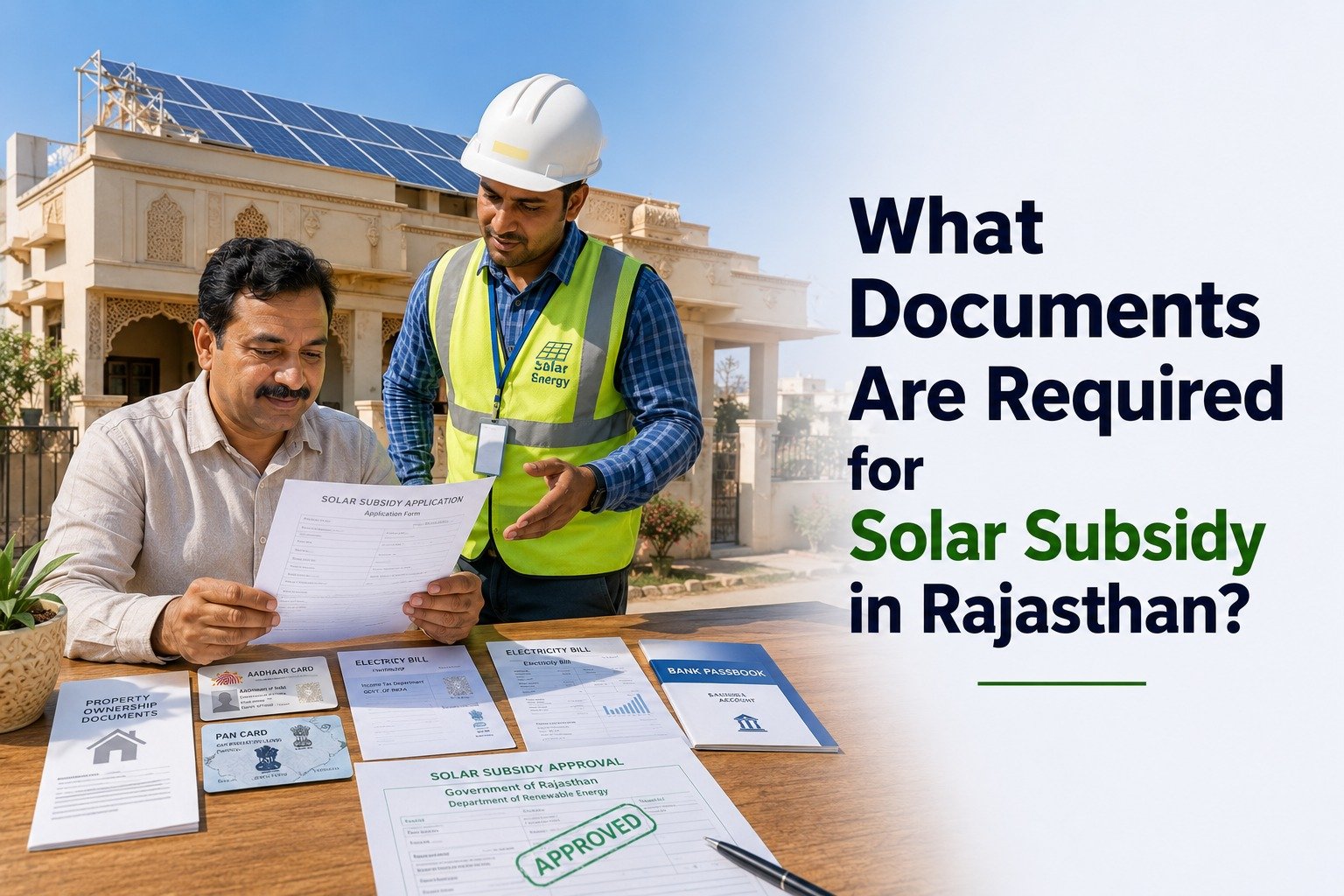
What Documents Are Required for Solar Subsidy in Rajasthan? (Complete Checklist 2026)
Thinking of installing solar panels but unsure about the paperwork? Missing even a single document can delay or reject your subsidy application.
The demand for rooftop solar systems is rapidly increasing across Rajasthan as homeowners and businesses look for ways to reduce electricity bills and switch to clean energy. Government initiatives like the PM Surya Ghar subsidy Rajasthan program and other rooftop solar subsidy schemes have made solar installations more affordable than ever before. However, one of the most critical steps in securing these financial benefits is submitting the correct documentation.
Many applicants face unnecessary delays due to incomplete or incorrect paperwork. Whether you are applying under a rooftop solar subsidy scheme for a residential property or planning a larger solar power system installation, proper documentation is essential. It helps authorities verify property ownership, electricity connection details, banking information, and installation compliance.
If you are planning to apply for a Rajasthan rooftop solar subsidy, understanding the required documents in advance can save time, prevent rejection, and speed up approval. This guide covers the complete document checklist, before-and-after installation requirements, common mistakes to avoid, and how expert support from EGPS can simplify the entire subsidy and net metering process.
What documents are required for a solar subsidy in Rajasthan?
To apply for a solar subsidy Rajasthan program, you need an Aadhaar card, PAN card, electricity bill, property ownership proof, bank details, rooftop photographs, and installation certificates. Additional documents like net metering approval and vendor invoices may also be required.
What Documents Are Required for a Rajasthan Rooftop Solar Subsidy?
The documents required for Solar Subsidy Rajasthan applications generally include:
- Aadhaar Card
- PAN Card
- Latest Electricity Bill
- Property Ownership Documents
- Bank Passbook or Cancelled Cheque
- Consumer Number and Electricity Connection Details
- Rooftop Photographs
- Installation Completion Certificate
- Net Metering Approval Documents
- Vendor Invoice and Warranty Papers
Submitting complete and accurate documents helps ensure faster approval under the rooftop solar subsidy scheme.
Understanding the Solar Subsidy Program in Rajasthan
The Rajasthan solar subsidy program encourages homeowners and eligible consumers to adopt solar energy by reducing the upfront cost of installation. Through government-supported initiatives and the rooftop solar subsidy scheme, consumers can install solar systems at lower costs while contributing to sustainable energy production.
Key Highlights
- Promotes renewable energy adoption
- Reduces dependency on conventional electricity
- Lowers monthly electricity bills
- Supports PM Surya Ghar Yojana objectives
- Available for eligible residential consumers
- Managed with the involvement of DISCOM authorities
- Requires proper documentation for verification and approval
The solar subsidy Rajasthan program is aligned with the latest Rajasthan solar policy, 2026, which focuses on increasing rooftop solar adoption and reducing electricity dependency across the state.
To apply for solar subsidy in Rajasthan, you must meet eligibility criteria, install a rooftop solar system through an approved vendor, complete DISCOM approval, and submit required documents. The subsidy amount can go up to ₹78,000 (central) plus additional state benefits.
Documents Required for PM Surya Ghar Subsidy Rajasthan
Under the PM Surya Ghar subsidy Rajasthan program, applicants must submit specific documents through the national solar portal to receive financial benefits. These documents help authorities verify eligibility, installation compliance, and banking details before releasing the subsidy.
Key Documents Required:
- Aadhaar card (linked with bank account)
- PAN card (for financial verification)
- Latest electricity bill
- Property ownership proof
- Bank account details (passbook or cancelled cheque)
- Rooftop photographs
- Installation completion certificate
- Net metering approval documents
Submitting accurate and complete documentation under the PM Surya Ghar subsidy Rajasthan scheme ensures faster processing and reduces the chances of rejection or delays.
Eligibility Criteria for Solar Subsidy in Rajasthan
To apply for solar subsidy benefits in Rajasthan, applicants must meet the eligibility criteria defined under the government solar subsidy scheme, including requirements related to property type, electricity connection, and installation standards.
Key Eligibility Requirements:
- Must be an Indian citizen
- Property should be residential (not commercial)
- Must have a valid electricity connection
- The applicant should be the owner of the property (or have owner consent)
- Rooftop must be suitable for solar installation
- The system must be installed through an MNRE-approved vendor
- Only one subsidy per household is allowed
Most subsidy programs, like the PM Surya Ghar subsidy in Rajasthan, are specifically designed for residential users.
Understanding solar panel subsidy eligibility Rajasthan is essential before applying, as only eligible residential consumers can receive benefits under the scheme.
Subsidy Amount in Rajasthan (Latest 2026)
The subsidy amount depends on the solar system capacity installed.
Central Government Subsidy (2026):
- 1 kW system → ₹30,000
- 2 kW system → ₹60,000
- 3 kW system → ₹78,000 (maximum limit)
The subsidy is capped at 3 kW capacity.
Rajasthan State Subsidy:
- Additional ₹17,000 (for eligible households)
Total Benefit:
Up to ₹95,000 subsidy (central + state combined)
Subsidy is transferred directly to your bank account after installation and approval.
DISCOM Approval Process in Rajasthan
DISCOM (Electricity Distribution Company) plays a crucial role in solar subsidy Rajasthan approval and net metering.
Step-by-Step DISCOM Process:
- Application Submission
- Apply on the national solar portal
- Upload electricity bill and documents
- Technical Feasibility Approval
- DISCOM checks load capacity and rooftop suitability
- Vendor Selection
- Choose an approved solar-solution company
- Installation of Solar System
- System installed as per guidelines
- Net Meter Installation
- DISCOM installs net meter
- Inspection & Verification
- Physical inspection of installed system
- Commissioning Approval
- System approved for grid connection
- Subsidy Release
- Funds credited after verification
DISCOM approval is mandatory before subsidy disbursement.
The net metering Rajasthan process is a crucial step, as it allows excess solar energy to be exported to the grid and ensures system compliance for subsidy approval.
How Net Metering Works in Rajasthan
The net metering Rajasthan process allows solar system owners to export excess electricity to the grid and receive credits on their electricity bills. This system ensures optimal utilization of solar power and plays a key role in subsidy approval and system performance validation.
Timeline for Solar Subsidy Approval (Days/Weeks)
The complete process takes around 45 to 90 days depending on documentation and approvals.
Typical Timeline Breakdown:
| Stage | Time Required |
|---|---|
| Installation Completion | 1–7 days |
| Net Meter Installation | 15–30 days |
| DISCOM Inspection | 7–15 days |
| Documentation Upload | 3–7 days |
| Subsidy Processing | 15–30 days |
| Bank Transfer | 7–15 days |
Total Time: 1.5 to 3 months (average)
Why Documents Are Important for Solar Subsidy Approval
Documentation forms the foundation of the subsidy approval process. Government agencies and DISCOMs use submitted documents to verify eligibility, ownership, installation details, and banking information before releasing subsidy funds.
Importance of Documentation
- Verifies applicant identity
- Confirms property ownership
- Validates electricity connection details
- Ensures correct bank account information
- Supports technical evaluation and approvals
- Helps prevent fraud and duplicate applications
- Speeds up subsidy disbursement
Need help with solar subsidy approval in Rajasthan? Get expert support for your solar journey with our solar subsidy and net metering assistance services.
List of Documents Required for Solar Subsidy in Rajasthan
Before applying for a solar panel subsidy program, applicants should collect all required documents. Proper preparation helps avoid delays and increases approval chances.
| Document Category | Purpose |
|---|---|
| Identity Proof | Verify applicant identity |
| Address Proof | Confirm residential address |
| Property Documents | Validate ownership |
| Bank Account Documents | Enable subsidy amount transfer |
| Electricity Connection Documents | Verify consumption and eligibility |
| Rooftop Photos | Assess installation area during inspection |
1. Identity Proof
Government authorities require valid identification to process subsidy applications.
A. Aadhaar Card
- Most commonly accepted identity document
- Used for applicant verification
- Often linked with subsidy records
B. PAN Card
- Required for financial verification
- Helps validate tax-related information
C. Voter ID
- Accepted as an alternative identity proof
D. Driving License
- Can be used as supporting identification
2. Address Proof
Address verification confirms that the installation site matches the applicant's records.
A. Electricity Bill
- Primary proof of installation location
- Contains consumer number and connection details
B. Water Bill
- Accepted as supporting address proof
C. Property Tax Receipt
- Confirms address and property details
3. Property Documents
Property ownership must be verified before approving a subsidy application.
A. Ownership Proof
- Establishes legal ownership of premises
B. Registry Copy
- Confirms ownership records
C. Property Tax Documents
- Supports ownership verification
4. Bank Account Documents
Government subsidy amounts are transferred directly to the applicant's bank account.
A. Passbook
- Displays account holder information
B. Cancelled Cheque
- Confirms account details
C. IFSC Details
- Required for electronic transfer of subsidy funds
5. Electricity Connection Documents
These documents help authorities verify electricity consumption and consumer eligibility.
A. Latest Electricity Bill
- Confirms active electricity connection
B. Consumer Number
- Used for verification and tracking
C. Connection Details
- Required during subsidy and net metering approval
6. Rooftop Photos
Photographs are often requested during inspection and verification.
A. Front View
- Shows property exterior
B. Roof View
- Displays available installation area
C. Installation Location
- Helps assess suitability for solar panels
This checklist also aligns with the standard solar subsidy documents list in India, ensuring compliance with both central and Rajasthan-specific subsidy requirements.
Documents Required Before Solar Installation
Before starting a rooftop solar installation, several documents are reviewed by solar vendors and DISCOM authorities. These documents help determine technical feasibility and eligibility under the rooftop solar subsidy scheme.
Required Documents Before Installation
- Site Survey Report
- Latest Electricity Bill
- Roof Suitability Assessment
- Consumer Verification Documents
- Net Metering Eligibility Documents
- Identity Proof
- Property Ownership Records
These documents help determine whether the property can safely support a solar power system and qualify for subsidy benefits.
Documents Required After Solar Installation
After installation, additional documents are necessary for inspection, net metering approval, and subsidy release.
Required Documents After Installation
- Installation Completion Report
- System Commissioning Certificate
- Net Metering Approval Certificate
- Vendor Invoice
- Warranty Documents
- Inspection Report
- Photographs of Installed Solar System
These documents confirm that the system has been installed according to approved standards and government guidelines.
Common Mistakes That Delay Solar Subsidy Approval
Many subsidy applications experience delays because of avoidable errors. Paying attention to documentation accuracy can significantly improve approval timelines.
Common Mistakes
- Incorrect Aadhaar details
- Name mismatch across documents
- Invalid bank account information
- Poor-quality rooftop photographs
- Missing signatures
- Incomplete application forms
- Wrong electricity consumer number
- Expired or unclear documents
- Missing property ownership records
- Incorrect net metering information
Tip: Always verify that the name on your Aadhaar card, electricity bill, bank account, and property documents match exactly before submission.
Why Solar Subsidy Applications Get Rejected in Rajasthan
Many applicants face delays or rejection in the solar subsidy Rajasthan process due to avoidable errors in documentation and application submission. Understanding these common reasons can help you improve your chances of approval.
Common Reasons for Rejection:
- Mismatch in name across Aadhaar, bank account, and electricity bill
- Incorrect or inactive bank account details
- Missing or incomplete documents
- Invalid electricity consumer number
- Poor-quality or unclear rooftop photographs
- Property ownership not properly verified
- Installation done by a non-approved vendor
- Errors in net metering application
- Failure to meet eligibility criteria under the rooftop solar subsidy scheme
To avoid rejection, always double-check your documents and ensure all details are consistent before submission. Working with an experienced solar solution company can significantly reduce errors and improve approval success.
How to Apply for Solar Subsidy in Rajasthan Step-by-Step
Applying for a solar energy subsidy becomes much easier when you follow a structured process.
Step 1: Check Eligibility
Confirm eligibility under the rooftop solar subsidy scheme and PM Surya Ghar Yojana guidelines.
Step 2: Select an Approved Solar Solution Company
Choose an experienced solar solution company capable of handling installation, documentation, and compliance requirements.
Step 3: Submit Required Documents
Provide identity, ownership, electricity, and banking documents.
Step 4: Install Rooftop Solar System
Complete installation through qualified professionals.
Step 5: Apply for Net Metering
Submit net metering Rajasthan application documents for DISCOM approval.
Step 6: Inspection Process
Authorities inspect the installed solar power system.
Step 7: Subsidy Approval
Verification and compliance checks are completed.
Step 8: Subsidy Transfer to Bank Account
The approved subsidy amount is transferred directly to the applicant's registered bank account.
With expert support from EGPS, applicants can avoid paperwork mistakes and complete the process smoothly. Get your subsidy approved faster with expert support.
Why Choose EGPS for Solar Subsidy Assistance?
Navigating subsidy applications, approvals, and net metering requirements can be challenging. EGPS simplifies the process with professional guidance and end-to-end support.
Benefits of Choosing EGPS
- Complete documentation support
- Expert net metering assistance
- Government compliance guidance
- Faster approval process
- End-to-end subsidy management
- Professional application review
- Dedicated customer support
- Experience in solar solutions India projects
Whether you are a homeowner or business owner, EGPS helps ensure that your application is accurate, compliant, and submitted correctly.
Conclusion
Applying for a solar subsidy Rajasthan program is one of the most effective ways to reduce the cost of installing a rooftop solar system. However, the success of your application depends heavily on accurate and complete documentation. Identity proofs, property ownership records, electricity bills, bank account details, rooftop photographs, and installation certificates all play a crucial role in securing timely approval.
The rooftop solar subsidy scheme is designed to promote clean energy adoption while reducing the financial burden on consumers. By ensuring every document is correct and properly submitted, applicants can avoid unnecessary delays and receive subsidy benefits faster. Additionally, completing the net metering approval process allows homeowners and businesses to maximize savings and returns from their solar investment.
Working with an experienced solar solution company can simplify the entire process. From document collection and application submission to DISCOM approvals, inspection, and subsidy transfer, expert guidance helps eliminate errors and ensures a smooth experience.
Need help with solar subsidy Rajasthan approval?
Our experts provide end-to-end support, including documentation, net metering, and subsidy processing, so you can enjoy a hassle-free solar installation journey.
If you are planning a rooftop solar installation and want reliable assistance with subsidy approval and net metering requirements in Rajasthan, EGPS is here to support you at every step.
Frequently Asked Questions
1. What documents are required for solar subsidy in Rajasthan?
To apply for a solar subsidy in Rajasthan, applicants typically need an Aadhaar Card, PAN Card, latest electricity bill, property ownership proof, bank passbook or cancelled cheque, consumer number details, rooftop photographs, installation certificates, and net metering approval documents. Complete documentation helps ensure faster approval under the rooftop solar subsidy scheme.
2. Is an Aadhaar card mandatory for a solar subsidy?
Yes, the Aadhaar Card is generally one of the primary identity documents required for solar subsidy applications. It helps government authorities verify applicant identity and process subsidy benefits efficiently. Applicants should ensure Aadhaar details match other submitted records to avoid delays in solar subsidy Rajasthan approval.
3. Can I apply for a rooftop solar subsidy without a PAN card?
Requirements may vary depending on the subsidy program and applicant category. While Aadhaar is often mandatory, a PAN card may also be required for financial verification. It is advisable to consult a professional solar solution company or subsidy assistance provider to understand the latest eligibility requirements.
4. How long does solar subsidy approval take?
The approval timeline depends on document accuracy, installation completion, inspection schedules, and DISCOM verification processes. In many cases, approval can take several weeks after successful inspection and submission of all required documents. Proper paperwork significantly reduces delays.
5. Do I need net metering for a solar subsidy?
Yes, Rajasthan's net metering approval is generally an important part of the process. It allows excess electricity generated by the solar power system to be exported to the grid and helps authorities verify system compliance before subsidy release.
6. What bank documents are required for subsidy transfer?
Applicants usually need a bank passbook, cancelled cheque, account number, and IFSC code. These documents ensure the approved solar energy subsidy amount is transferred directly to the correct bank account without processing issues.
7. Can commercial buildings get a solar subsidy?
Subsidy eligibility varies based on current government guidelines. Residential consumers often receive direct benefits under programs such as PM Surya Ghar Yojana. Commercial building owners should consult experienced solar solutions India experts for the latest subsidy and incentive information.
8. Who can apply for a solar subsidy in Rajasthan?
Eligible residential electricity consumers with suitable rooftop space can generally apply for solar subsidy Rajasthan benefits. Applicants must meet government requirements, have a valid electricity connection, and submit all required documentation during the application process.
9. How much subsidy is available under the rooftop solar subsidy scheme?
The subsidy amount depends on system capacity and current government policies. Benefits are typically calculated based on approved solar panel capacity. Applicants should verify the latest subsidy structure before installation to maximize financial benefits.
10. What is the net metering Rajasthan process?
The net metering Rajasthan process allows solar users to send excess electricity back to the grid and receive bill credits. It is an essential step in subsidy approval and requires DISCOM verification and meter installation.
11. Why should I hire a solar solution company for subsidy assistance?
A professional solar solution company helps with site assessment, documentation, installation compliance, net metering applications, inspections, and subsidy paperwork. Their expertise reduces errors, speeds up approvals, and ensures that applicants receive the maximum benefit available under government programs.