Step-by-Step Process to Apply for PM Surya Ghar Solar Subsidy Scheme
If you are planning to install rooftop solar at home, the PM Surya Ghar Muft Bijli Yojana can significantly reduce the upfront cost through Central Financial Assistance (CFA). For homeowners in Rajasthan, the scheme is particularly relevant because the state has been actively expanding residential rooftop solar adoption.
According to the Rajasthan Economic Review 2025–26, 493 MW of rooftop solar capacity had been installed for 1.22 lakh consumers in Rajasthan by December 2025. Rajasthan has also set a target of installing rooftop solar plants in 5 lakh households under PM Surya Ghar.
But applying for a solar subsidy is not simply about installing panels and waiting for the money. The process involves registration, selecting an eligible vendor, obtaining approvals, installation, inspection, net metering procedures, and submitting the required information for subsidy release.
This guide explains the step-by-step process to apply for the rooftop solar subsidy scheme, with specific information useful for homeowners looking for solar subsidies in Rajasthan and solar solutions and solar panel installation in Jaipur.
What Is the PM Surya Ghar Rooftop Solar Subsidy Scheme?
PM Surya Ghar: Muft Bijli Yojana is a Government of India initiative designed to encourage residential consumers to install grid-connected rooftop solar systems.
The scheme provides central financial assistance for eligible residential rooftop solar installations. Under the current CFA structure, residential consumers can receive:
| Rooftop Solar Capacity | Central Financial Assistance |
|---|---|
| 1 kW | Up to ₹30,000 |
| 2 kW | Up to ₹60,000 |
| 3 kW | Up to ₹78,000 |
| Above 3 kW | Maximum ₹78,000 |
The official guidelines specify CFA of ₹30,000 per kW for the first 2 kW and ₹18,000 for the additional 1 kW, with no additional CFA beyond 3 kW.
For example, a 2.5 kW eligible system can receive a CFA of ₹69,000 under the stated structure.
It is important to understand that the subsidy is not a blanket discount on every solar installation. Eligibility, system configuration, approved processes, and DISCOM requirements must be satisfied.
Read more: How Much Subsidy Can You Get on Rooftop Solar in Rajasthan?
Who Can Apply for PM Surya Ghar Solar Subsidy?
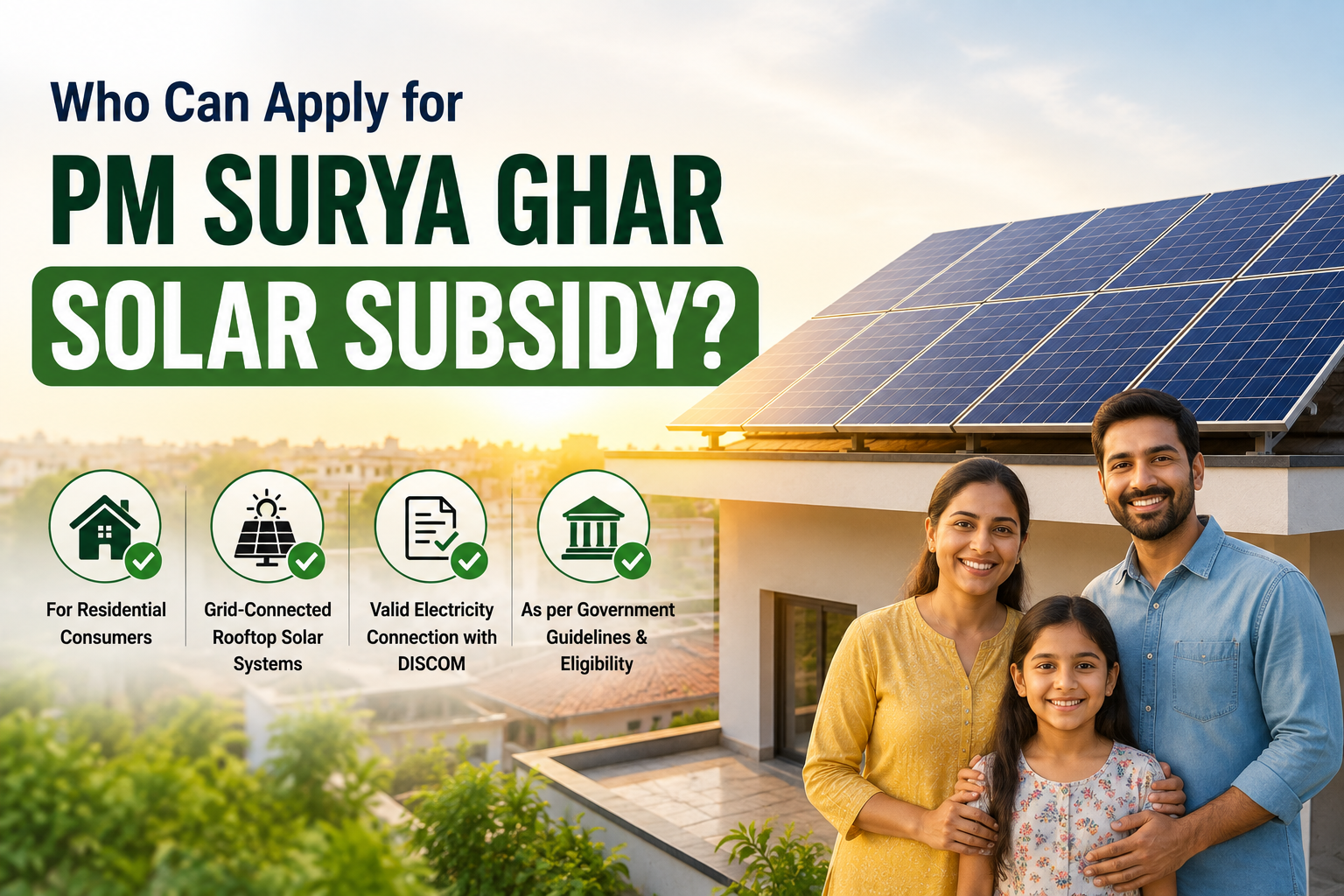
The scheme primarily supports eligible residential consumers with grid-connected rooftop solar systems.
The official implementation guidelines define an eligible residential rooftop solar plant as a grid-connected system associated with a residential electricity connection of the local DISCOM. Eligible installations can include systems installed on a roof, terrace, balcony, or elevated structure, subject to applicable requirements.
Before applying, homeowners should generally verify:
- You have a valid residential electricity connection.
- The rooftop solar system is eligible under the scheme.
- Your electricity connection is associated with the relevant DISCOM.
- The installation follows applicable technical requirements.
- The installation and documentation are completed through the prescribed process.
- The selected vendor and equipment meet applicable scheme requirements.
Because eligibility and implementation requirements can change, applicants should verify the latest requirements on the official portal before making a financial commitment.
Step-by-Step Process to Apply for Rooftop Solar Subsidy
Applying for the PM Surya Ghar subsidy involves more than simply purchasing and installing solar panels. Homeowners need to complete several stages, including checking their electricity requirements, registering on the official portal, selecting an eligible vendor, completing DISCOM formalities, installing the system, and completing the required verification.
Here is the step-by-step process to help you understand what to expect.
Step 1: Check Your Electricity Consumption
Before applying for rooftop solar, review your electricity bills from the previous several months.
Look at:
- Monthly electricity consumption
- Average monthly bill
- Sanctioned load
- Electricity connection details
- DISCOM name
- Existing meter information
Your electricity consumption helps determine what size of solar system may be suitable for your household.
For example, a household with relatively high daytime electricity consumption may benefit from a larger rooftop solar system than a household with very low consumption.
However, system sizing should not be based only on electricity usage. Roof area, shadow conditions, sanctioned load, budget, future electricity demand, and applicable DISCOM requirements should also be considered.
Step 2: Check Your Rooftop's Solar Potential
A solar installation needs suitable space with adequate sunlight.
Before proceeding, assess:
- Available roof area
- Direction and orientation
- Shading from nearby buildings
- Trees and water tanks
- Structural condition of the roof
- Possible locations for the inverter
- Cable routing
- Accessibility for maintenance
This is especially important when selecting solar solutions in Jaipur, where rooftop conditions can vary considerably between independent houses, apartments, and commercial-style residential buildings.
A professional site assessment can help identify whether the proposed solar capacity is technically practical.
Step 3: Register on the PM Surya Ghar Portal
The application process begins through the official PM Surya Ghar system.
Applicants need to provide relevant electricity connection and consumer information during registration.
Keep essential information available, such as:
- Mobile number
- Electricity consumer number
- DISCOM information
- Electricity bill details
- Residential address
- Bank account information where required
- Other documents requested by the portal
Applicants should use the official government portal and avoid submitting sensitive information to unofficial websites claiming to process the subsidy.
Step 4: Select an Appropriate Rooftop Solar Vendor
After registration, the next important step is choosing an eligible solar vendor.
Do not select a vendor based only on the lowest quotation.
Compare:
- Solar panel specifications
- Inverter quality
- Warranty
- Installation experience
- System capacity
- Mounting structure
- Protection equipment
- Installation workmanship
- After-sales service
- Documentation support
- Net-metering assistance
- Subsidy process support
A reliable solar company should explain the complete installation process instead of focusing only on panel prices.
For homeowners searching for solar panels in Jaipur, choosing a company that can assist with installation, approvals, net metering, and documentation can make the overall process much easier.
Step 5: Finalize the Solar System Capacity
Once the site has been assessed, determine the appropriate system size.
Common residential systems include:
- 1 kW
- 2 kW
- 3 kW
- 5 kW
- Higher-capacity systems where technically and financially appropriate
The subsidy calculation has a maximum CFA limit of ₹78,000 for residential systems under the stated structure, even when the installed system exceeds 3 kW.
Therefore, installing a larger system does not automatically mean receiving a larger central subsidy.
The right capacity should instead be determined by electricity consumption, available roof space, future requirements, and project economics.
Step 6: Complete the Required Approvals
After selecting the vendor and system configuration, the project moves through the applicable DISCOM approval process.
This stage may involve:
- Application processing
- Technical feasibility or related approval
- Vendor coordination
- Installation scheduling
- Metering-related requirements
The exact workflow can differ according to the electricity distribution utility and the current portal process.
This is one reason why professional solar solutions providers can be useful: they can help homeowners understand the documentation and coordination required at each stage.
Step 7: Install the Rooftop Solar System
After the necessary approvals, the solar system can be installed.
A typical residential rooftop solar installation includes:
- Solar PV modules
- Mounting structures
- Solar inverter
- DC and AC cables
- Protection devices
- Earthing arrangements
- Junction/combiner equipment where required
- Monitoring system
- Metering components as applicable
Installation should follow applicable technical and safety requirements.
Do not treat installation as simply placing panels on a roof. The mounting structure, electrical protection, cable management, earthing, and inverter installation all affect the safety and long-term performance of the system.
Step 8: Complete Inspection and Net-Metering Formalities
Once the system has been installed, the relevant DISCOM process must be completed.
For grid-connected rooftop solar, net metering allows electricity generated by the solar system to interact with the household's electricity consumption according to the applicable regulations and metering arrangement.
The exact process, inspection requirements, and meter-related procedures depend on the local DISCOM.
For Rajasthan homeowners, this step is particularly important because the rooftop solar project must be coordinated with the relevant electricity distribution utility.
Step 9: Submit the Required Documents for Subsidy
After installation and completion of the required formalities, the applicant must ensure that all necessary information and documentation have been submitted through the prescribed process.
Depending on the application workflow, information may include the following:
- Consumer details
- Solar installation details
- Bank account information
- Installation documentation
- Meter information
- Vendor-related information
- Required declarations or certificates
A common mistake is assuming that installing the solar panels automatically completes the subsidy process.
It does not.
The applicant should track the application and ensure that every required stage has been completed.
Step 10: Receive the Eligible Solar Subsidy
Once the installation, verification, and required documentation are successfully completed, the eligible central financial assistance can be processed according to the scheme's procedure.
The Rajasthan Economic Review notes that PM Surya Ghar uses an online system for registration, approval, and grant disbursement.
This makes it important to keep your application information accurate and monitor the status of the application rather than relying only on verbal updates from a vendor.
Read more: How to Apply for a Solar Subsidy in India
How Much Solar Subsidy Can You Get in Rajasthan?
If you are planning to install a residential rooftop solar system in Rajasthan, the PM Surya Ghar Muft Bijli Yojana can help reduce the initial installation cost through Central Financial Assistance (CFA).
For eligible residential consumers, the current central subsidy is based on the installed solar capacity:
| Solar System Capacity | Central Solar Subsidy |
|---|---|
| 1 kW | Up to ₹30,000 |
| 2 kW | Up to ₹60,000 |
| 3 kW | Up to ₹78,000 |
| Above 3 kW | Maximum ₹78,000 |
The subsidy is calculated at ₹30,000 per kW for the first 2 kW and ₹18,000 for the additional 1 kW. The central subsidy is capped at ₹78,000, so installing a system larger than 3 kW does not increase the central CFA beyond this amount.
Is There an Additional Solar Subsidy in Rajasthan?
In addition to the central assistance available under PM Surya Ghar, certain eligible households in Rajasthan may qualify for additional support under state-specific programs.
According to the Rajasthan Economic Review 2025–26, eligible consumers covered under the 150 Units Nishulk Bijli Yojana can receive the central assistance provided by MNRE along with an additional ₹17,000 state subsidy.
This means eligible households may potentially receive support from both the central and state governments. However, the additional ₹17,000 is not applicable to every residential solar installation. Eligibility depends on the applicable Rajasthan government scheme and the consumer's specific circumstances.
Example: How Much Subsidy Could You Receive?
For a standard eligible 3 kW residential rooftop solar system:
- Central CFA: Up to ₹78,000
- Additional Rajasthan support: Up to ₹17,000 for eligible consumers under the applicable state programme
- Potential combined assistance: Up to ₹95,000 for qualifying households
The ₹95,000 figure should be treated as an eligibility-based maximum, not a guaranteed subsidy for every 3 kW installation.
If you are considering a solar subsidy in Rajasthan, it is important to look beyond the headline subsidy amount. Your final financial benefit depends on the solar system capacity, eligibility, applicable government schemes, installation cost, and other project requirements.
Before purchasing a system, verify your eligibility and understand the applicable subsidy structure. Working with an experienced solar provider can also help you navigate documentation, installation, net metering, and subsidy-related procedures.
For homeowners looking for solar solutions in Jaipur and across Rajasthan, understanding the available financial assistance before installation can help you make a more informed decision and accurately estimate your upfront investment.
PM Surya Ghar Solar Subsidy in Jaipur
Jaipur is emerging as a major hub for residential rooftop solar adoption in Rajasthan, making government-backed solar incentives increasingly relevant for homeowners looking to reduce electricity costs and switch to renewable energy.
According to the Rajasthan Economic Review 2025–26, Jaipur recorded 110,627 kW of rooftop solar capacity under PM Surya Ghar by December 2025, the highest installed capacity among the districts reported in the review.
For homeowners, this growing adoption highlights the increasing importance of understanding solar subsidies in Jaipur, rooftop installation requirements, and the process for connecting a residential solar system to the electricity grid.
If you are planning to install a rooftop solar system in Jaipur, the subsidy should be considered as one part of the overall investment. Before choosing a system, evaluate:
- Your average monthly electricity consumption
- Available rooftop area
- Shade and sunlight exposure
- Suitable solar system capacity
- Quality of solar panels and inverter
- Installation and mounting quality
- Net-metering requirements
- DISCOM approvals and documentation
- Warranty and after-sales support
- Eligibility for applicable government subsidies
Choosing the right system based on your actual electricity requirements can help you get better long-term value from your investment.
Homeowners searching for solar panels in Jaipur, rooftop solar installation, or residential solar solutions should choose a provider that can support more than just the physical installation.
A complete solar service should ideally cover system assessment, capacity planning, installation, documentation, net-metering coordination, and guidance through the applicable subsidy process.
With Jaipur already recording substantial rooftop solar adoption under PM Surya Ghar, homeowners can benefit from understanding the process and available incentives before making an installation decision.
Read more: What Documents Are Required for Solar Subsidy in Rajasthan?
Documents You May Need for Solar Subsidy Application

Before applying for the rooftop solar subsidy scheme, it is important to keep the required information and documents ready. Having accurate documents can make the registration, installation, verification, and subsidy process smoother and help prevent avoidable delays.
The exact requirements may vary depending on the PM Surya Ghar application process, your electricity distribution company (DISCOM), and the stage of your solar installation. However, homeowners should generally keep the following information available:
- Recent electricity bill – Used to verify your residential electricity connection and consumer details.
- Consumer/account number – Your electricity consumer number should match the information entered during registration.
- Registered mobile number – Keep the mobile number linked to your electricity connection or application readily available for communication and verification.
- Residential address – Ensure the address provided in the application is consistent with your electricity connection details.
- Identity information – Identification documents or details may be requested where applicable during the application or verification process.
- Bank account details – Accurate bank information may be required for eligible subsidy disbursement.
- Solar system details – Keep information about the installed rooftop solar capacity, equipment, and installation available.
- Vendor-related documents – Installation invoices, agreements, or other documents provided by the selected solar vendor may be required.
- Metering information – Details related to the existing or newly installed meter and net-metering process may be required.
- Installation photographs or certificates – Depending on the applicable process, photographs, inspection records, or installation-related certificates may be requested.
Before submitting your application, carefully check that your name, consumer number, electricity connection details, mobile number, and bank account information are accurate and consistent across the relevant documents.
Even a small mismatch can result in additional verification or delay the processing of your application.
If you are applying for a solar subsidy in Rajasthan, it is also advisable to keep digital copies of your electricity bills, payment records, installation documents, and vendor communications. These records can be useful if you need to track the application or respond to a documentation request later.
Most importantly, always verify the latest document requirements through the official PM Surya Ghar portal and your respective DISCOM, as application procedures and documentation requirements may be updated from time to time.
Common Mistakes to Avoid When Applying for Rooftop Solar Subsidy
Applying for the rooftop solar subsidy scheme can be straightforward when you understand the process and complete each stage correctly. However, homeowners can face unnecessary delays, additional costs, or confusion if they overlook important requirements.
Here are some common mistakes to avoid when applying for PM Surya Ghar solar subsidy.
1. Choosing a Solar Vendor Only on Price
A low-cost quotation may look attractive, but the cheapest option is not always the most cost-effective in the long run.
Before selecting a solar company, compare:
- Solar panel and inverter specifications
- Product warranties
- Installation quality
- Mounting structure
- Electrical safety equipment
- Experience with residential installations
- After-sales service
- Net-metering assistance
- Subsidy and documentation support
A reliable vendor should provide a complete solution rather than competing only on the initial installation price.
2. Installing Solar Before Understanding the Subsidy Process
One of the biggest mistakes is assuming that any rooftop solar installation automatically qualifies for government subsidy.
Before making a payment or starting installation, understand the applicable eligibility criteria, vendor requirements, approvals, and documentation process.
Following the prescribed process from the beginning can help prevent complications later.
3. Choosing the Wrong Solar System Size
Installing the largest possible system is not necessarily the best decision.
Your solar capacity should be determined by factors such as:
- Average electricity consumption
- Available rooftop space
- Roof orientation and shading
- Sanctioned electrical load
- Future electricity requirements
- Budget
- Applicable DISCOM requirements
A professional site assessment can help determine the appropriate system capacity for your home.
4. Ignoring Net-Metering Requirements
For grid-connected rooftop solar systems, net metering and related DISCOM procedures are an important part of the installation process.
Ignoring these requirements can create problems during approval, inspection, or meter installation.
Before installing your system, understand the applicable metering process and confirm that your selected vendor can assist with the required DISCOM formalities.
5. Providing Incorrect Bank or Consumer Information
Errors in important information can lead to verification issues and unnecessary delays during subsidy processing.
Before submitting your application, carefully verify:
- Consumer number
- Applicant name
- Mobile number
- Electricity connection details
- Bank account information
- Other required application details
Make sure the information is consistent with the relevant supporting documents.
6. Failing to Track Your Application
Submitting the application is not necessarily the end of the process.
Keep records of:
- Application details
- Approval status
- Vendor information
- Installation documents
- Invoices and payment records
- Inspection details
- Metering information
- Subsidy-related communications
Regularly checking the application status can help you identify if any action or additional documentation is required.
7. Relying on Unofficial Subsidy Websites or Agents
Government solar subsidy schemes can attract misleading advertisements, unofficial websites, and individuals promising guaranteed subsidy payments.
Be cautious when sharing personal, electric, or banking information.
For applications, eligibility information, and status updates, rely on official government sources and your respective DISCOM. If a solar company is assisting you, verify the information independently before making financial or documentation-related decisions.
8. Focusing Only on the Subsidy Amount
The subsidy can reduce the upfront cost, but it should not be the only factor when choosing a solar system.
Consider the complete investment, including:
- Solar equipment quality
- Installation cost
- Expected electricity generation
- Warranty
- Maintenance
- Net-metering arrangements
- Long-term electricity savings
- After-sales support
A slightly higher-quality installation may provide better long-term value than choosing a system solely because it offers the lowest initial quotation.
9. Not Checking the Rooftop Before Installation
Roof conditions can significantly affect the performance and practicality of a solar system.
Before installation, check for:
- Shade from trees or buildings
- Water tanks
- Roof obstructions
- Structural issues
- Available installation area
- Safe access for maintenance
A professional rooftop assessment can help identify these issues before the installation begins.
10. Not Keeping Copies of Important Documents
Keep digital and physical copies of your electricity bills, application information, invoices, installation documents, approvals, meter-related records, and other relevant paperwork.
These records can be useful when tracking your solar subsidy in Rajasthan, resolving discrepancies or requesting support after installation.
How to Choose the Right Solar Solutions for Your Home

Choosing a rooftop solar system is a long-term investment, so the decision should not be based only on the available government subsidy or the lowest installation quote. The right solar solutions should be designed around your electricity consumption, rooftop conditions, budget, equipment quality, and long-term energy requirements.
Before choosing a solar provider, consider the following factors.
1. Check Solar Panel Quality and Warranty
Solar panels are one of the most important components of a rooftop solar system. Compare the panel's specifications, efficiency, warranty terms, and expected performance before making a decision.
Instead of choosing a panel simply because it is inexpensive, look for products that offer a suitable combination of:
- Panel efficiency
- Performance warranty
- Product warranty
- Manufacturer reliability
- Applicable technical certifications
- Suitability for local weather conditions
A quality panel can contribute to consistent energy generation throughout its operating life.
2. Choose the Right Inverter
The inverter converts the electricity generated by the solar panels into usable electricity for your home and plays a critical role in the overall system.
When comparing inverters, consider:
- Appropriate capacity
- Efficiency
- Compatibility with the solar panels
- Monitoring capabilities
- Warranty
- Safety and protection features
- Manufacturer support
The inverter should be selected as part of the overall system design rather than purchased separately based only on price.
3. Prioritize Professional Installation
Even high-quality solar equipment can underperform if it is installed incorrectly.
A professional installation should include the following appropriate items:
- Mounting structures
- Cable management
- Earthing
- Electrical protection
- Inverter placement
- Waterproofing considerations
- Safety measures
Proper installation can improve system reliability, safety, and long-term performance while reducing the risk of avoidable maintenance issues.
4. Get a Proper Rooftop Assessment
Your rooftop should be evaluated before the system is finalized.
The assessment should consider:
- Available installation area
- Sunlight exposure
- Shading from nearby buildings and trees
- Roof orientation
- Existing rooftop structures
- Structural condition
- Access for cleaning and maintenance
A professional assessment helps determine whether the proposed solar capacity is practical for your property and whether any potential shading or installation challenges need to be addressed.
5. Compare After-Sales Service
A rooftop solar system is a long-term investment, so support should not end when installation is completed.
Before choosing a provider, ask about:
- Equipment warranty
- Installation warranty
- Maintenance support
- Troubleshooting
- Inverter service
- System monitoring
- Response time for service requests
For homeowners searching for solar panels in Jaipur, choosing a provider with reliable local support can be particularly useful for future maintenance and service requirements.
6. Check Subsidy and Documentation Assistance
The solar installation process can involve registration, approvals, installation documentation, inspection, net metering, and subsidy-related procedures.
An experienced solar provider should clearly explain the following:
- Applicable subsidy requirements
- Required documentation
- Installation process
- DISCOM procedures
- Net-metering formalities
- Application tracking
- Post-installation requirements
This can make the overall process easier, particularly for homeowners applying for a solar subsidy in Rajasthan for the first time.
7. Compare the Complete Solar Package
When comparing quotations from different companies, do not compare only the final price.
Check what is actually included in each proposal, such as:
- Solar panels
- Inverter
- Mounting structure
- Wiring and cables
- Protection equipment
- Earthing
- Installation
- Monitoring system
- Net-metering assistance
- Subsidy-related support
- Warranty
- After-sales service
A detailed comparison helps you understand the actual value offered by each provider and reduces the risk of unexpected costs later.
The best rooftop solar solution is not necessarily the cheapest one. It should provide the right balance of system capacity, equipment quality, installation standards, safety, expected energy generation, warranty, and service support.
If you are planning a residential solar installation in Jaipur or elsewhere in Rajasthan, evaluate the complete project rather than focusing only on the subsidy amount. A properly designed and professionally installed system can help you make better use of available rooftop space and maximize the long-term benefits of your solar investment.
Read more: Which Solar System is Best for Home Use in 2026?
Is Rooftop Solar Worth Installing in Rajasthan?
Rajasthan has strong solar potential and is already seeing significant growth in residential rooftop installations.
The state's Economic Review reported 493 MW of rooftop solar capacity across 1.22 lakh consumers by December 2025 under PM Surya Ghar.
For homeowners, the potential benefits of rooftop solar include:
- Lower dependence on grid electricity
- Potential reduction in electricity bills
- Government financial assistance for eligible systems
- Greater use of renewable energy
- Long-term energy cost management
- Potential improvement in household energy resilience
However, actual savings depend on system size, electricity consumption, solar generation, tariff structure, roof conditions, financing costs, and maintenance.
Therefore, homeowners should evaluate the complete project economics instead of focusing only on the subsidy.
Conclusion
Applying for the rooftop solar subsidy scheme becomes much easier when you understand the process before installation.
From checking electricity consumption and assessing your roof to selecting a suitable vendor, completing DISCOM formalities, installing the system, and submitting the required documents, every stage matters.
For homeowners in Rajasthan, the opportunity is particularly significant. The state recorded 493 MW of rooftop solar capacity for 1.22 lakh consumers by December 2025, while Jaipur accounted for the highest installed capacity among the districts highlighted in the Rajasthan Economic Review.
If you are planning to install solar panels in Jaipur, do not look at the subsidy alone. Evaluate the complete solar solution—including system sizing, equipment quality, installation, net metering, documentation, and long-term service.
A properly planned rooftop solar system can turn government financial assistance into a practical long-term energy investment.
Need help understanding rooftop solar subsidies, net metering, and installation requirements? Explore EGPS's solar net-metering and subsidy assistance services to understand the process and get professional guidance.
Frequently Asked Questions
1. What is the PM Surya Ghar rooftop solar subsidy scheme?
The PM Surya Ghar Muft Bijli Yojana is a government initiative that provides central financial assistance to eligible residential consumers installing grid-connected rooftop solar systems.
2. How much rooftop solar subsidy can I get in Rajasthan?
Eligible residential consumers can receive up to ₹30,000 for 1 kW, ₹60,000 for 2 kW and ₹78,000 for 3 kW or higher systems, subject to the applicable scheme conditions.
3. Is a solar subsidy available for homes in Jaipur?
Yes, eligible residential consumers in Jaipur can apply for the PM Surya Ghar subsidy through the prescribed government process, subject to applicable DISCOM and scheme requirements.
4. Can I get an additional solar subsidy in Rajasthan?
Certain eligible consumers may qualify for additional state support under applicable Rajasthan government programs. Eligibility should be verified before assuming that additional assistance is available.
5. How do I apply for PM Surya Ghar solar subsidy?
The process generally involves registering through the official PM Surya Ghar portal, providing electricity connection details, selecting an eligible vendor, completing approvals, installing the system, completing inspection and metering formalities, and submitting the required documentation.
6. What documents are required for a rooftop solar subsidy?
Applicants may need their electricity bill, consumer number, mobile number, residential details, bank account information, solar installation details, and other documents requested during the application and verification process.
7. Does installing solar panels automatically qualify me for a subsidy?
No. The solar installation must meet the applicable scheme requirements, and the prescribed registration, installation, verification, documentation, and other formalities must be completed.
8. Is net metering required for rooftop solar subsidies?
For grid-connected rooftop solar systems, applicable metering and DISCOM procedures form an important part of the process. The exact requirements can vary according to the relevant electricity distribution company.
9. How do I choose the right solar system for my home?
Consider your electricity consumption, available rooftop space, sunlight and shading, sanctioned load, future electricity requirements, budget, equipment quality, and applicable DISCOM requirements before selecting the system capacity.
10. How can I choose the right solar company in Jaipur?
Compare solar companies based on equipment quality, installation experience, warranties, system design, after-sales service, documentation assistance, net-metering support and experience with solar panel installation in Jaipur, rather than choosing a provider only on the basis of price.